📋 Table of Contents
▼

Table of Contents
Rhode Island’s Unclaimed Property Database
Before the creation of statewide unclaimed property databases, you may have been able to search county-by-county for unclaimed property. In Rhode Island, this would have meant searching in Bristol, Kent, Newport, Providence, and Washington Counties. Today, all of the unclaimed property in Rhode Island is listed in a single state database, saving you having to perform multiple searches.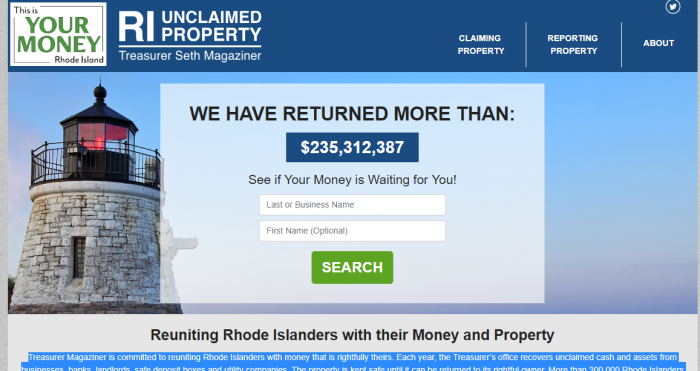
What is Unclaimed Property / Money?
While each state specifically defines what unclaimed property is for that state, the term has a relatively consistent meaning when used to describe property in the United States. According to the state of Rhode Island, unclaimed property refers to abandoned financial assets, which are without activity for a certain period of time. The holder makes efforts to contact the owner, and, when those efforts are unsuccessful, the holders then report the assets to the state of the owner’s last known address. Some examples of unclaimed property include: unpaid wages, life insurance payouts, securities, checking accounts, savings accounts, uncashed checks, and the proceeds of safe deposit boxes. Vehicles and real property are both exempted from the unclaimed property statutes.How Much Unclaimed Money is in Rhode Island?
Rhode Island currently has over $300 million in unclaimed property, with over 300,000 people on the unclaimed property lists. This is only a small portion of the unclaimed property available in the United States. According to The National Association of Unclaimed Property Administrators (NAUPA), there is more than $42 billion in unclaimed property available in the United States.Rhode Island’s Unclaimed Money Finder
Rhode Island’s Your Money program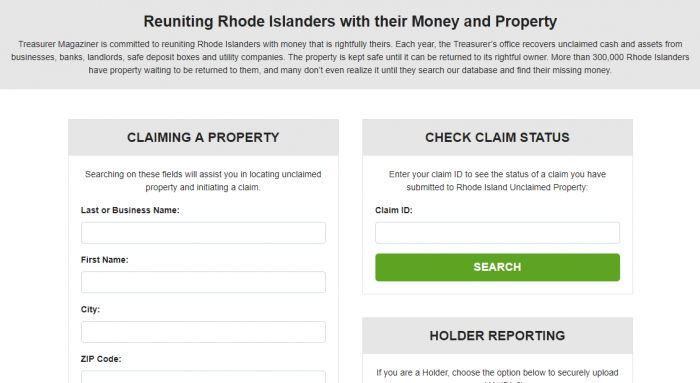 The claiming a property function has four areas for input: last or business name, first name, city, and zip code. However, you do not need all of that information to run a search; you can begin a search with just the last name or business name.
We run the same search in each state, so that you can easily compare information across all of our tutorials. For those searches, we use the common name Bob Smith. We chose a common name on purpose, because there are some pitfalls of searching for a common name. The search results may return a large number of potential hits, requiring you to narrow your search results. We start by searching by last name only, and quickly discover that there are over 1,000 results when we do so, which means that the results we do receive are going to be incomplete:
The claiming a property function has four areas for input: last or business name, first name, city, and zip code. However, you do not need all of that information to run a search; you can begin a search with just the last name or business name.
We run the same search in each state, so that you can easily compare information across all of our tutorials. For those searches, we use the common name Bob Smith. We chose a common name on purpose, because there are some pitfalls of searching for a common name. The search results may return a large number of potential hits, requiring you to narrow your search results. We start by searching by last name only, and quickly discover that there are over 1,000 results when we do so, which means that the results we do receive are going to be incomplete:
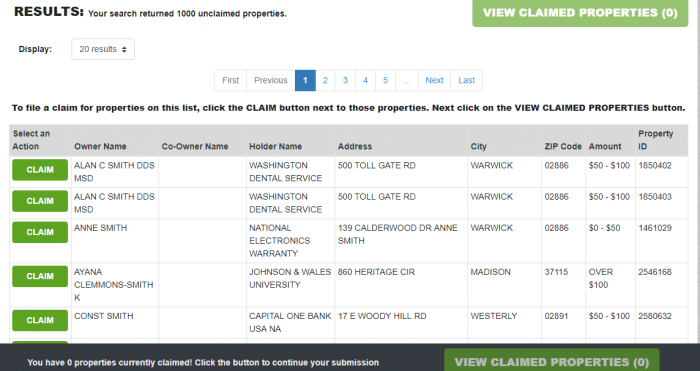 Many states, including Rhode Island, cap the number of search results you can see at 1,000. This means that, when we get 1,000 results for a search, we have no idea of knowing if there are really 1001 results or 10,000 results. The only way to get the information we need is to narrow the search. Therefore, we go ahead and add in the first name Bob. Unfortunately for us, it seems like Bob Smith is a fairly common name in Rhode Island, because we still get over 1,000 results:
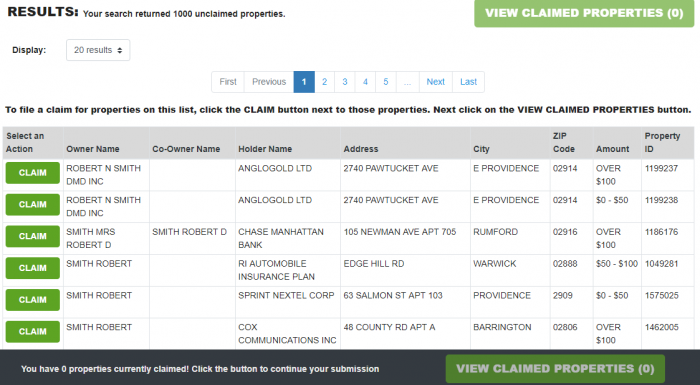 Why did adding the first name not seem to narrow down the results? There could be several reasons for this, but looking at the search results helps us find the answer. In some states, searching for Bob Smith will only return exact matches. However, in Rhode Island, the search for Bob smith apparently pulls up similar names, because you can see that the results include Robert Smith. This means that you are not going to have to run several similar searches for variations on the name Bob. However, it unfortunately also means that you have more search results than you can use.
The next step is to narrow down your search results by including the city. The city is not the location of the older, but the location of the property owner’s last known address. You could also choose to use zip code rather than city, if you have that information. For this search, we are going to use the city of Providence:
Why did adding the first name not seem to narrow down the results? There could be several reasons for this, but looking at the search results helps us find the answer. In some states, searching for Bob Smith will only return exact matches. However, in Rhode Island, the search for Bob smith apparently pulls up similar names, because you can see that the results include Robert Smith. This means that you are not going to have to run several similar searches for variations on the name Bob. However, it unfortunately also means that you have more search results than you can use.
The next step is to narrow down your search results by including the city. The city is not the location of the older, but the location of the property owner’s last known address. You could also choose to use zip code rather than city, if you have that information. For this search, we are going to use the city of Providence:
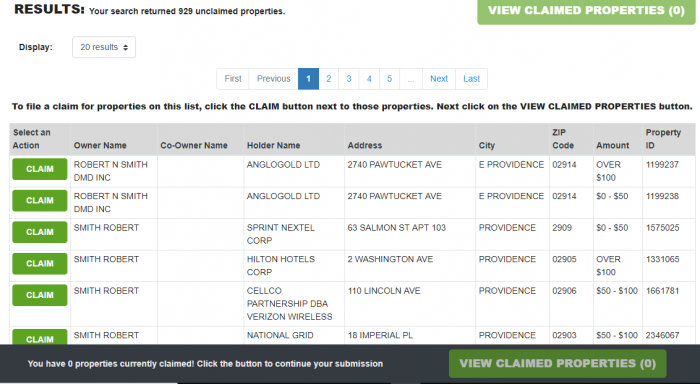 Apparently Bob Smiths are pretty common in Providence, because we still get 929 unclaimed properties. However, we have at least managed to narrow it down to a manageable number of search results and can be confident that the results include all of the possible hits. Because 929 is still a relatively unworkable number, we are going to further narrow it down by adding in a zip code. We chose 02903:
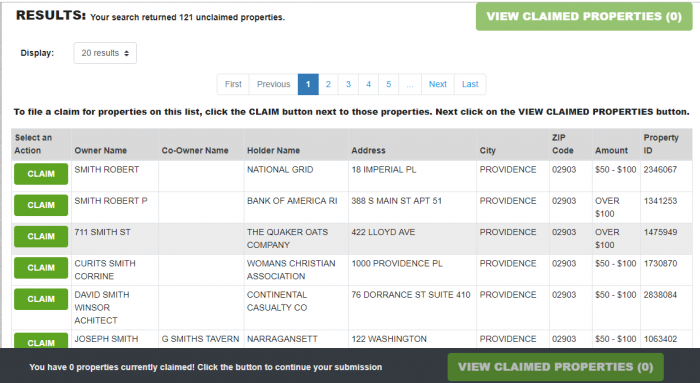 Limiting the search in that way gets us down to a workable 121 results. We can then start to look at what the results say. Each result has the same information: a claim button on the left, the owner name, co-owner name (if applicable), the holder’s name, the owner’s last known address, the city, the zip code, the range for the amount of the claim, and the claim’s associated property ID number.
To claim a property, you hit the claim button to the left of the property:
Limiting the search in that way gets us down to a workable 121 results. We can then start to look at what the results say. Each result has the same information: a claim button on the left, the owner name, co-owner name (if applicable), the holder’s name, the owner’s last known address, the city, the zip code, the range for the amount of the claim, and the claim’s associated property ID number.
To claim a property, you hit the claim button to the left of the property:
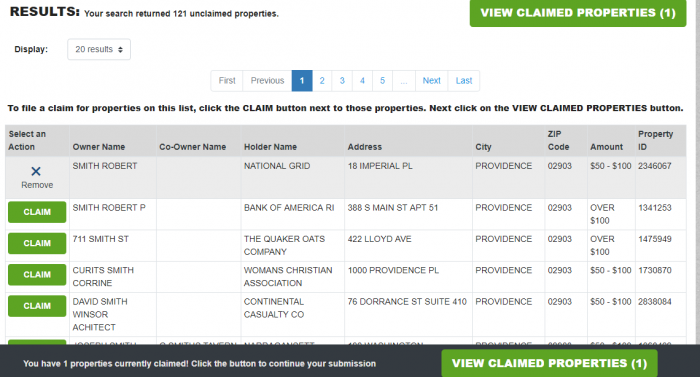 Once you have selected all of the properties you want to claim, you hit the view claimed properties button on the top right or bottom right of the page, and you get to a page that looks like this:
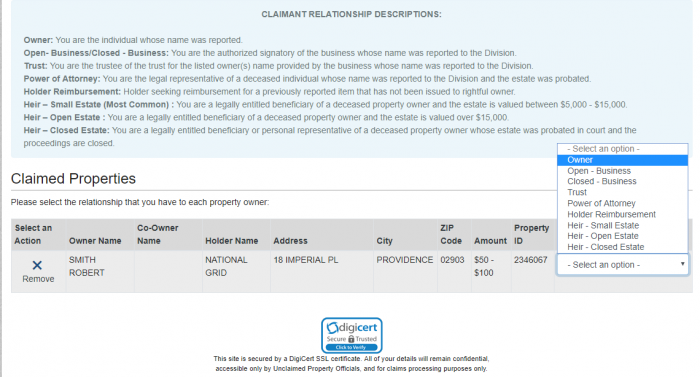
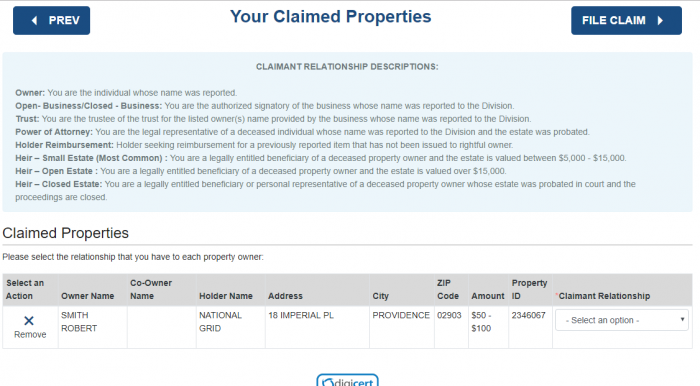 For each property, you will be asked to select your relationship to the property/ property owner. The options are defined in the material above and will appear in a drop-down box under claimant relationship on the far right of each property. The options are owner, open business, closed business, power of attorney, holder reimbursement, heir small estate, heir open estate, and heir closed estate. If you are the claimant on several properties, select the appropriate relationship for each property:
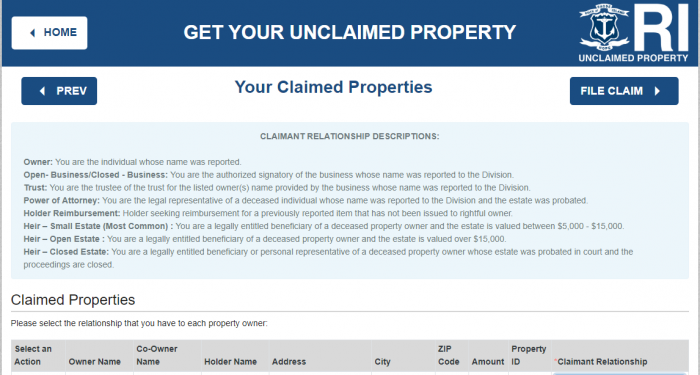
 Once you have picked all of the relationships, hit the file claim button on the top right of the page:
 You will be taken to a screen that asks for your contact information. The requested information will include: he information requested includes the claimant type, last name, first name, middle name, date of birth, email address, home phone, social security or tax id number, address, and how you heard about the program:
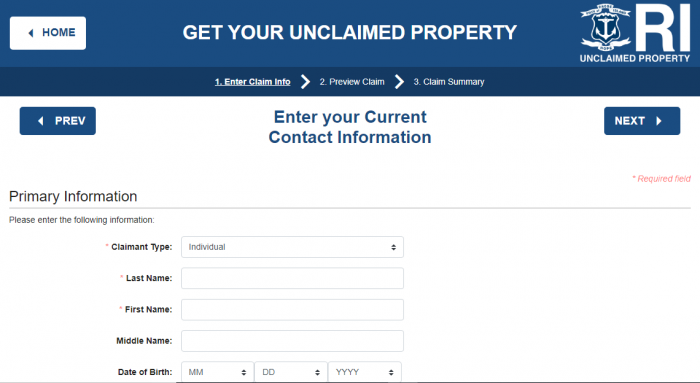 Once you have completed the information, you hit the next button. What appears next depends on what documentation you have to require and whether you need to take any additional steps. Follow all of the instructions that you receive on that screen.
Unclaimed Property Laws in Rhode Island
You can find Rhode Island’s unclaimed property laws in Rhode Island Statutes § 33-21.Rhode Island Unclaimed Property FAQ
How long does Rhode Island hold unclaimed money? In most states, the state holds unclaimed property for an indefinite period of time. Rhode Island is no exception; once it lists property as unclaimed it will hold that property until the property owner or the property owner’s heirs can claim the property. Examples of Unclaimed Money Almost any type of intangible person property can become unclaimed property. Some of the most common types of property that become unclaimed property are savings accounts, checking accounts, uncashed checks, unpaid wages, stocks, bonds, dividends, refunds, and the contents of safe deposit boxes (which may be liquidated). Some types of property are exempted from the unclaimed property laws, including real property and motor vehicles. Does the state of RI make efforts to locate owners? Rhode Island’s Your Money Program makes outreach efforts several times a year, but its main effort to locate owners is the easy-to-use database. Other sources to search besides RI state database? If you are starting an unclaimed property search in Rhode Island, you might think that you only need to search in the state to find your property. However, that is simply not true. Even if you have only lived in Rhode Island, some types of property never revert to the state’s custody; and, if you only search the Rhode Island unclaimed property database, you will never uncover that property. In addition, even if you have only ever lived in one state, you might be surprised to find out that it is possible to have money in other state databases. If you have ever established business contacts in a state, you could have money in their unclaimed money database. In addition, if anyone has ever purchased property in your name in another state, your property might be in that database. Finally, if you are running a search for ancestors, in addition to your own name, you may have money in other states. When you make a comprehensive list of every place you should search in your quest to find and reclaim your unclaimed property, we suggest you start by making a list of any state you should reasonably be including in your search. On this list, you should include every state where you have lived and states where ancestors lived. If you have business contacts outside of your state, go ahead and include those other states, as well. Next, you need to understand what type of property never escheats to the states’ unclaimed money lists. Federal money stays with the federal government and will not show up on unclaimed money lists. In addition, some other types of funds, like some unclaimed life insurance benefits, will not show up on state unclaimed property lists because the insurer does not have a known address for the intended beneficiary. That is why we suggest that almost everyone look at four sites that are outside of the state databases: the Internal Revenue Service (IRS), the Pension Benefit Guaranty Corporation, the U.S. Treasury, and the Life Insurance Policy Locator. Most people do not think of the IRS when they go to search for their unclaimed money, but the IRS processes money for more people than any other entity in the United States. Some of that money gets lost from the original owner. In fact, more of it becomes unclaimed than you might imagine, in no small part due to the IRS’s policy of not forwarding income tax refunds if they are undeliverable to the address provided by the tax payer on the tax return. You can find out more about that policy on the IRS’s website: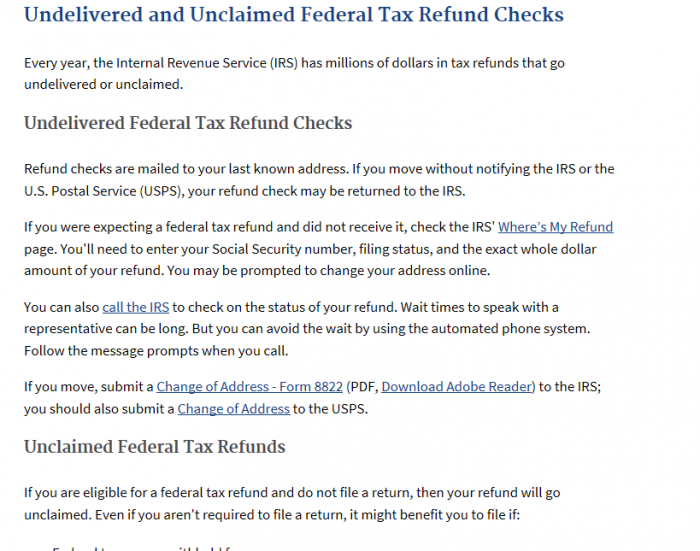 If you realize that your personal information has changed since you filed a return, but that you did not update that information with the IRS, they may be holding your return. Fortunately, the IRS has an easy-to-use Where’s My Refund? page, to help you locate your money:
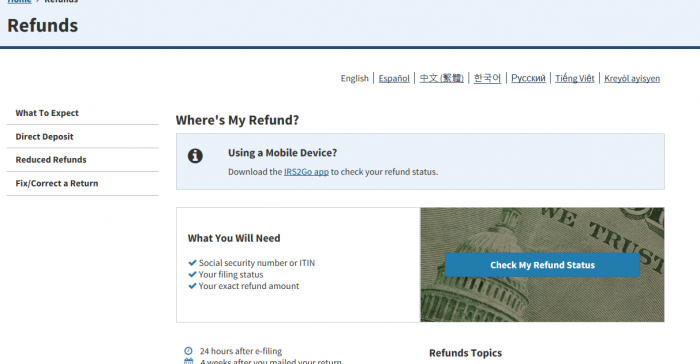 The IRS is not the only federal government agency that is in charge of processing money for a lot of Americans. The U.S. Treasury also processes a huge amount of money for people, in the form of U.S. Treasury bonds. In fact, this type of property might be especially vulnerable to becoming unclaimed because people often purchase it for others as gifts. Unfortunately, the U.S. Treasury does not make it easy to find and claim your unclaimed property. They used to operate an unclaimed property database that worked similarly to state databases and made finding and claiming your unclaimed bonds a breeze. They discontinued that service. However, you can still get help locating and claiming your unpaid bonds by contacting them at 844-284-2676 or visit Treasury Direct for more information:
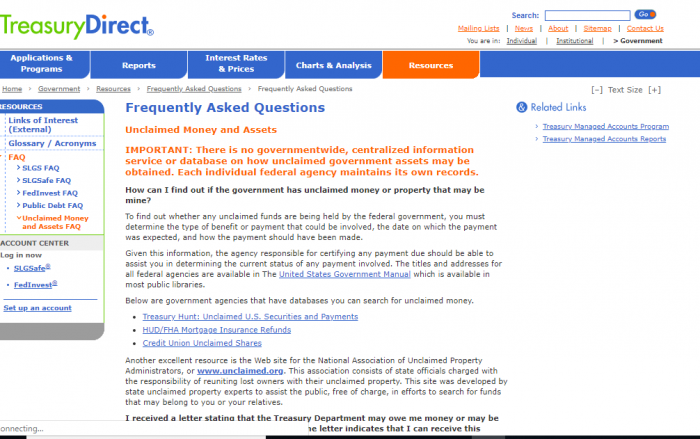 Some federal agencies are not strictly governmental, but are more like regulatory agencies for private enterprises. The Pension Benefit Guaranty Corporation (PBGC) is one of those; while it is a federal agency, it actually guarantees private pension benefits. Many people do not even realize that they have unpaid pension benefits because pensions are no longer a regular part of people’s compensation packages. However, particularly for older workers, there may be earned and unpaid pensions benefits simply waiting to be claimed. You can look for yours on the PBGC’s unclaimed pension database:
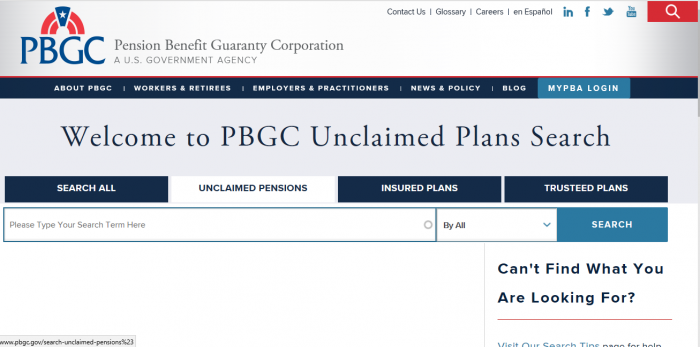 Of course, not all privately owed money is regulated by a federal agency. For example, even though many unpaid life insurance benefits never show up in state databases, there is no federal database to help you find them. However, there is a private national-level organization that can help you. The National Association of Insurance Commissioners’ Life Insurance Policy Locator Service has set up a service where you can provide them with your information, which they will then distribute to their member agencies, so that those insurers can check to see if you are the beneficiary on any unclaimed life insurance policies:
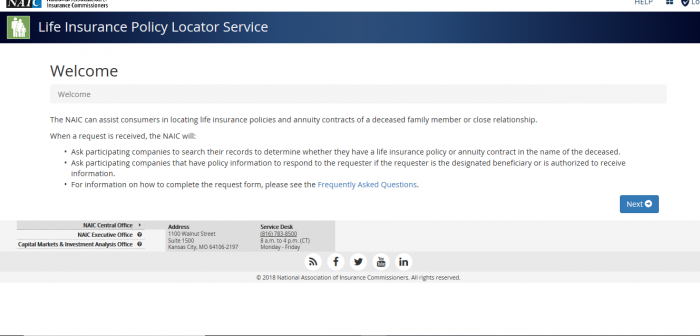 In addition to those four sites we suggest almost everyone check, there are some situation-dependent sites that you may need to check as well. They include, but are not limited to: the FDIC, the Department of Housing and Urban Development, the National Credit Union Administration, and the Veteran’s Administration Benefits Department.
What is the best way prevent my property from becoming lost or unclaimed?
One of the most frequent questions we get is how to prevent property from becoming unclaimed. Unclaimed property is probably best described as forgotten property; most people lose their money because they forget that they have it. You can prevent this from happening by keeping detailed records of all of your accounts and setting up regular dates (usually once a year) to contact your financial institutions. In addition, make sure and contact all of those financial institutions anytime you have a change in personal information, such as a name change or change in address. If electronic account management is an option, choose it, making sure to use a personal email address and not a work email.
How do I make sure my heirs know where my assets are if I die?
Once you have made detailed records of your accounts, pick a trusted individual and tell them how to access your financial records in the event that you die or are incapacitated.
Should I hire a finder to conduct the search?
Finder services are legal in Rhode Island, and they can save you time in your search for unclaimed funds. However, recovering the money from the state has no fee associated, so you have to weigh whether the time savings are worth whatever potential fee you could pay.
Why does Rhode Island take possession of unclaimed property?
Unclaimed property laws are consumer protection laws, which are designed to make it easier for consumers to find and claim their unclaimed property.
In addition to those four sites we suggest almost everyone check, there are some situation-dependent sites that you may need to check as well. They include, but are not limited to: the FDIC, the Department of Housing and Urban Development, the National Credit Union Administration, and the Veteran’s Administration Benefits Department.
What is the best way prevent my property from becoming lost or unclaimed?
One of the most frequent questions we get is how to prevent property from becoming unclaimed. Unclaimed property is probably best described as forgotten property; most people lose their money because they forget that they have it. You can prevent this from happening by keeping detailed records of all of your accounts and setting up regular dates (usually once a year) to contact your financial institutions. In addition, make sure and contact all of those financial institutions anytime you have a change in personal information, such as a name change or change in address. If electronic account management is an option, choose it, making sure to use a personal email address and not a work email.
How do I make sure my heirs know where my assets are if I die?
Once you have made detailed records of your accounts, pick a trusted individual and tell them how to access your financial records in the event that you die or are incapacitated.
Should I hire a finder to conduct the search?
Finder services are legal in Rhode Island, and they can save you time in your search for unclaimed funds. However, recovering the money from the state has no fee associated, so you have to weigh whether the time savings are worth whatever potential fee you could pay.
Why does Rhode Island take possession of unclaimed property?
Unclaimed property laws are consumer protection laws, which are designed to make it easier for consumers to find and claim their unclaimed property.
Conclusion
Rhode Island’s Your Money Program has helped reunite thousands of people with millions of dollars. Could you be next?Search Unclaimed Money in Other States
Looking for unclaimed money in a different state? Browse all 50 states below to find unclaimed property in your area.
ALAlabamaAKAlaskaAZArizonaARArkansasCACaliforniaCOColoradoCTConnecticutDEDelawareFLFloridaGAGeorgiaHIHawaiiIDIdahoILIllinoisINIndianaIAIowaKSKansasKYKentuckyLALouisianaMEMaineMDMarylandMAMassachusettsMIMichiganMNMinnesotaMSMississippiMOMissouriMTMontanaNENebraskaNVNevadaNHNew HampshireNJNew JerseyNMNew MexicoNYNew YorkNCNorth CarolinaNDNorth DakotaOHOhioOKOklahomaOROregonPAPennsylvaniaSCSouth CarolinaSDSouth DakotaTNTennesseeTXTexasUTUtahVTVermontVAVirginiaWAWashingtonWVWest VirginiaWIWisconsinWYWyoming