📋 Table of Contents
▼

Table of Contents
 The Virginia Treasury operates Virginia’s Unclaimed Property Program and operates its own unclaimed money database. The program’s stated goal is to return “money, stocks, bonds, dividends, utility deposits, insurance proceeds, tangible property and more to the rightful owners.” It does this by having private holders turn over property to the Commonwealth, and then safeguarding that property for the rightful owners. Rightful owners can search for their property, and, once found, file a claim with the Treasury.
Virginia actually allows people to search in three different ways for missing property. At the website, you can choose to search for yourself, search for a business, or search for a deceased:
The Virginia Treasury operates Virginia’s Unclaimed Property Program and operates its own unclaimed money database. The program’s stated goal is to return “money, stocks, bonds, dividends, utility deposits, insurance proceeds, tangible property and more to the rightful owners.” It does this by having private holders turn over property to the Commonwealth, and then safeguarding that property for the rightful owners. Rightful owners can search for their property, and, once found, file a claim with the Treasury.
Virginia actually allows people to search in three different ways for missing property. At the website, you can choose to search for yourself, search for a business, or search for a deceased:
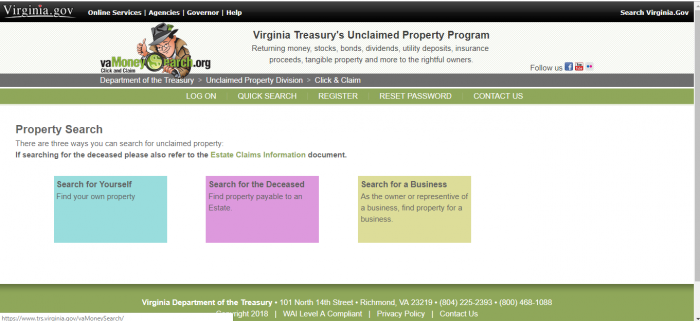 Those searching for the deceased should look at the Estate Claims Information document available on their website for further information about that process.
One of the biggest mistakes that people make when conducting a search for unclaimed property is that they only look in their state of residence. It is important to search for unclaimed property in any state where you have lived. However, what many people do not realize is that, even if you have only ever lived in Virginia, you may need to search other places for abandoned property. First, some types of property, like tax returns and U.S. savings bonds, are never turned over to states for safekeeping. In addition, other types of property, such as life insurance policies or pensions, may be held in the state where a company is headquartered, rather than the state of residence.
Contemplating an asset search can be overwhelming because there are multiple steps involved in the search. While there may be multiple steps, the states have actually done their best to make the process simple and straightforward. States, most territorial governments, and even branches of the federal government have developed tools that you can use to find and claim your abandoned property. Therefore, while the process may be time-consuming, it is not really complex.
Those searching for the deceased should look at the Estate Claims Information document available on their website for further information about that process.
One of the biggest mistakes that people make when conducting a search for unclaimed property is that they only look in their state of residence. It is important to search for unclaimed property in any state where you have lived. However, what many people do not realize is that, even if you have only ever lived in Virginia, you may need to search other places for abandoned property. First, some types of property, like tax returns and U.S. savings bonds, are never turned over to states for safekeeping. In addition, other types of property, such as life insurance policies or pensions, may be held in the state where a company is headquartered, rather than the state of residence.
Contemplating an asset search can be overwhelming because there are multiple steps involved in the search. While there may be multiple steps, the states have actually done their best to make the process simple and straightforward. States, most territorial governments, and even branches of the federal government have developed tools that you can use to find and claim your abandoned property. Therefore, while the process may be time-consuming, it is not really complex.
What is Unclaimed Money?
Whether you call it unclaimed money, unclaimed property, abandoned money, or abandoned property, the terms refer to property that has an identifiable monetary value, but which has been effectively abandoned by its true owner. Determining whether property has been abandoned depends on the state laws governing property in that state; different types of property and different types of holders have different periods of no-contract with the original owners that are required before the property can be considered abandoned. In Virginia, the abandoned property law is Virginia Code §55-210.2:1 et al.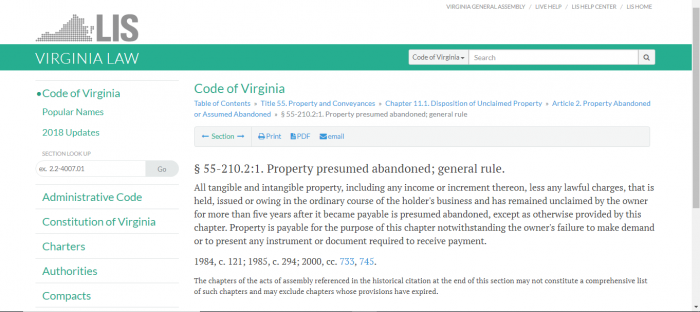
How Much Unclaimed Money is in Virginia?
While unclaimed property amounts are constantly fluctuating, due to people making claims and holders reporting newly abandoned property, Virginia currently has over $1 billion in unclaimed property. This is a disproportionate amount, given that Virginia is not one of the most highly populated states. According to the National Association of Unclaimed Property Administrators (NAUPA), a nationwide organization devoted to caring for unclaimed property, there is currently about $42 billion in unclaimed property in the United States. Virginia having a larger share of that money means that it is especially important for people in Virginia to run an unclaimed property search!Virginia Unclaimed Money Finder
Virginia operates its own Click & Claim unclaimed money finder. You have two options when beginning your search. You can register at the site, which makes it possible for you to log in and helps you avoid the additional step of registering in the future, as well as preserving your current search results. If you do not want to register or log in, you can also search through the results without logging into the site.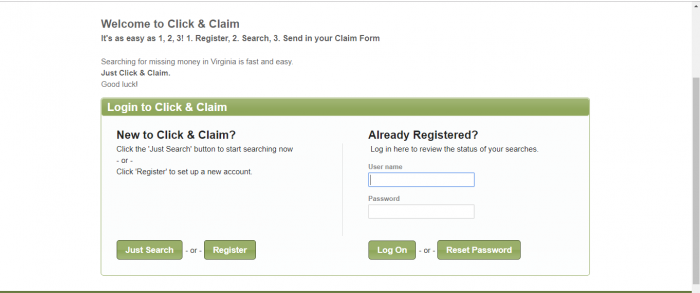 As with other states, the Commonwealth of Virginia’s unclaimed property site has information for all of its 96 counties. That means you can go to this one central location for information on all of the following counties: Accomack, Albemarle, Alleghany, Amelia, Amherst, Appomattox, Arlington, Augusta, Bath, Bedford, Bland, Botetourt, Brunswick, Buchanan, Buckingham, Campbell, Caroline, Carroll, Charles City, Charlotte, Chesterfield, Clarke, Craig, Culpeper, Cumberland, Dickenson, Dinwiddie, Essex, Fairfax, Fauquier, Floyd, Fluvanna, Franklin, Frederick, Giles, Gloucester, Goochland, Grayson, Greene, Greensville, Halifax, Hanover, Henrico, Henry, Highland, Isle of Wight, James City, King and Queen, King George, King William, Lancaster, Lee, Loudoun, Louisa, Lunenburg, Madison, Mathews, Mecklenburg, Middlesex, Montgomery, Nelson, New Kent, Northampton, Northumberland, Nottoway, Orange, Page, Patrick, Pittsylvania, Powhatan, Prince Edward, Prince George, Prince William, Pulaski, Rappahannock, Richmond, Roanoke, Rockbridge, Rockingham, Russell, Scott, Shenandoah, Smyth, Southampton, Spotsylvania, Stafford, Surry, Sussex, Tazewell, Warren, Washington, Westmoreland, and Wise.
Because Virginia lets you search three different ways, you may need different information for each search. For the search for your own personal property, all you need to begin your search is your name. You can search just by last name, or by different variations combining your last name with a full or partial first name and/or middle name:
As with other states, the Commonwealth of Virginia’s unclaimed property site has information for all of its 96 counties. That means you can go to this one central location for information on all of the following counties: Accomack, Albemarle, Alleghany, Amelia, Amherst, Appomattox, Arlington, Augusta, Bath, Bedford, Bland, Botetourt, Brunswick, Buchanan, Buckingham, Campbell, Caroline, Carroll, Charles City, Charlotte, Chesterfield, Clarke, Craig, Culpeper, Cumberland, Dickenson, Dinwiddie, Essex, Fairfax, Fauquier, Floyd, Fluvanna, Franklin, Frederick, Giles, Gloucester, Goochland, Grayson, Greene, Greensville, Halifax, Hanover, Henrico, Henry, Highland, Isle of Wight, James City, King and Queen, King George, King William, Lancaster, Lee, Loudoun, Louisa, Lunenburg, Madison, Mathews, Mecklenburg, Middlesex, Montgomery, Nelson, New Kent, Northampton, Northumberland, Nottoway, Orange, Page, Patrick, Pittsylvania, Powhatan, Prince Edward, Prince George, Prince William, Pulaski, Rappahannock, Richmond, Roanoke, Rockbridge, Rockingham, Russell, Scott, Shenandoah, Smyth, Southampton, Spotsylvania, Stafford, Surry, Sussex, Tazewell, Warren, Washington, Westmoreland, and Wise.
Because Virginia lets you search three different ways, you may need different information for each search. For the search for your own personal property, all you need to begin your search is your name. You can search just by last name, or by different variations combining your last name with a full or partial first name and/or middle name:
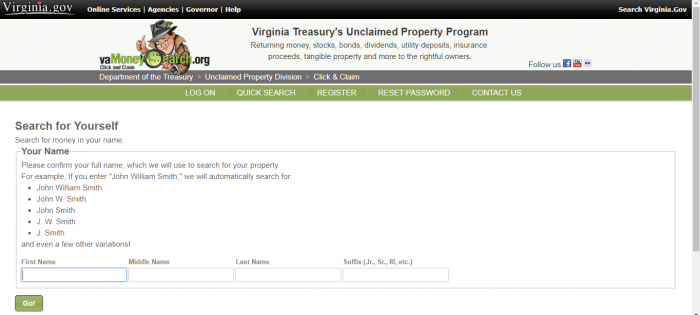 While being able to search only using your last name can simplify the search process, it comes with its own risks. If you have a fairly common last name, you are going to identify a substantial amount of unclaimed property that is not yours if you only search by last name.
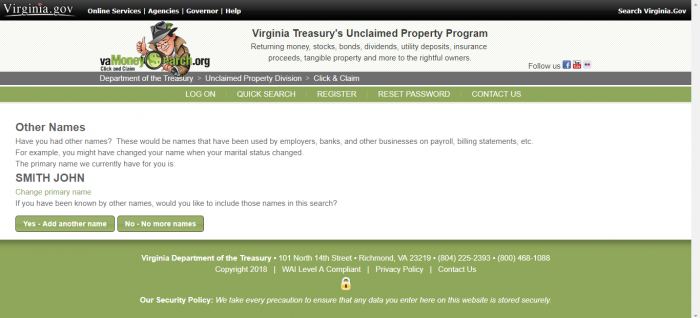
Another issue you might encounter is that you may have gone by multiple names, such as nicknames or middle names. The Virginia unclaimed property site lets you search for your other names in a single search:
While being able to search only using your last name can simplify the search process, it comes with its own risks. If you have a fairly common last name, you are going to identify a substantial amount of unclaimed property that is not yours if you only search by last name.
Another issue you might encounter is that you may have gone by multiple names, such as nicknames or middle names. The Virginia unclaimed property site lets you search for your other names in a single search:
 In addition, the Virginia website allows you to search by social security number, or actually, the last seven digits of your social security number. While this function is optional, it can really help you narrow down results to property that is likely to belong to you:
 Once you have entered your search parameters, the website will return a list of cities where it has located money matching your parameters. You then select all of the cities where you have had addresses:
 After you have selected the cities where you have lived, the search engine returns the street names associated with each of those cities. You can then select the street names for places where you have resided:
 If you have had a joint account, the website provides an option allowing you to select property with joint owners. After you have gone through these steps, you get a list of property that might belong to you. The list includes property type, amount, and who reported the property:
 To claim your money, you either have to register or log in with the registration money you already established. To register, you will need a username, an email address, and a password:
 Once you are registered, you will be provided with options on how to proceed with your claim. You will be able to save your progress, complete an online claim form, receive instructions on what documentation is necessary to prove your claim, and receive information on how to provide your documentation to the Unclaimed Property Program.
Unclaimed Money Laws in Virginia
In Virginia, the abandoned property law is Virginia Code §55-210.2:1 et al:
Virginia Unclaimed Money FAQ
How long does Virginia hold unclaimed money? The Virginia Department of the Treasury holds unclaimed monetary indefinitely. It auctions off tangible items on a regular basis, but then hold the proceeds from those auctions for the property owner indefinitely. It will not store some items at all, including items that it deems to be dangerous, flammable, explicit, obscene, or illegal. It will store paperwork and documents for a period of up to 20 years, before destroying them. Examples of Unclaimed Money According to the Virginia Department of the Treasury, unclaimed funds can be generated in just about any type of financial transaction with businesses, financial institutions, or government agencies. Examples of unclaimed funds include bank accounts, investments, securities, deposits, refunds, unpaid wages, insurance policy money, outstanding checks, and safe deposit box contents. Items left in storage units or apartments generally are not considered unclaimed property because of the terms of the rental contracts. Does state of VA make efforts to locate owners? Yes. First, Virginia requires the holders of property to send a notification to owners that property has escheated to the state. Next, Virginia publishes lists of unclaimed property in newspapers. It will also make efforts to send letters to owners, notifying them that it has custody of the property. Other sources to search besides VA state database? If you have only ever lived in Virginia, you might believe that you only need to search for unclaimed property in Virginia. However, that might not be true. We recommend that everyone take a few minutes to make a list of places they need to search, so that you can make sure your abandoned property search is comprehensive. If a step does not apply to you, skip it. First, you will want to make a list of all the states that might be holding abandoned property for you. This includes all of the states where you have lived, even as a child. If your parents are from other states, you might want to check them as well, especially if you have relatives that may have held property for you in those states. Then, think about states where you may have had business contacts. If your employer or a life insurance agency was headquartered in another state, we suggest adding them to your list. Then you will want to look at the following non-state websites to look for other types of abandoned property: the U.S. Treasury, the IRS, the National Pension Benefit Guaranty Corporation, and the Life Insurance Policy Locator Service. The U.S. Treasury has over $17 billion in unclaimed savings bonds, making it a huge source of unclaimed property. Unfortunately, it is also one of the most difficult-to-access resources. Although it had a user-friendly lost savings bond database at its Treasury Direct website, it discontinued that service, making it more difficult to actual owners to claim their abandoned property. However, they still offer information on how to claim your lost bonds. You can also contact them at 844-284-2676 or writing to the Bureau of Public Debt. Many people do not realize that the Internal Revenue Service does not forward tax refund checks and it also does not ever turn those funds over to the state, making it another must-search site for people looking for their abandoned property, especially if you moved after filing taxes but before getting your tax return.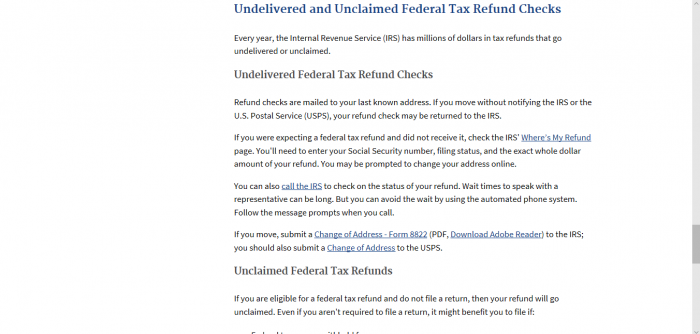 The IRS also offers a handy refund locator service on its Where’s My Refund? page:
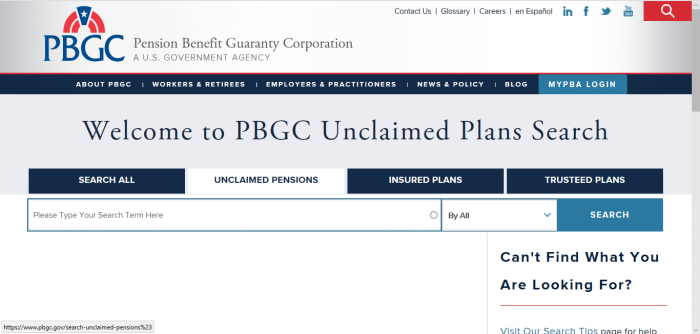
 Many people are unaware that pension benefits are guaranteed by the federal government, even though they are maintained by private companies. That can make locating unclaimed pension benefits relatively easy. Simply search for your name at the Pension Benefit Guaranty Corporation website, which has over $400 million in unclaimed pension benefits, belonging to over 70,000 potential claimants. We consider this an essential part of any unclaimed property search; there is at least one million-dollar pension that has not been claimed!
 Do you think you may have been the beneficiary, or the descendent of a beneficiary, in an unclaimed life insurance policy? While there is no aggregate database for life insurance policies like there is for pension benefits, the National Association of Insurance Commissioners’ Life Insurance Policy Locator Service offers a database that allows you to put in your information. It then distributes that information to its member agencies, and they check to see if you match any of their beneficiaries. The process is not difficult, but it does not provide the same instantaneous results as other search methods.
 You also need to think about any circumstances that might have you looking at other databases. Is your family from another country that has unclaimed property databases? Do you fall into any special groups that might have group-specific that handle unclaimed, abandoned, or even stolen property outside of the United States? If so, you might want to check those databases. One such database that we suggest that anyone of Jewish descent or with a known connection to anyone who was a victim of the Holocaust check is the Holocaust Survivors and Victims Database.
 How do I make sure my heirs know where my assets are if I die?
One of the biggest misconceptions we hear from people is that if they have a will, they have done everything that they need to do in order to get their assets to their loved ones. This simply is not true. While a will directs how to divide your assets, it does not say where to find them. Therefore, you must make sure that a trusted person, usually the one named as your administrator or executor, has access to your detailed financial information, including addresses and keys for any safety deposit boxes or storage units.
How can I prevent my property from becoming lost or unclaimed?
Keeping detailed financial records is the first step to never abandoning your property. All of your financial records should be kept in a central location and include the following information: the name of the financial institution or other holder; the name you used to open the account; the account numbers; the date you opened the account; when deposits are due back to you; the amount of the account of deposit; the physical address of the holder; and phone numbers for the holder. If property is in a safety deposit box, storage unit, or other physical location, include the address and box or unit number, as well as a key for that location or instructions on where to find the key if you do not have a duplicate.
Abandoned property generally occurs because someone has moved, making it impossible for a holder to locate them. To prevent lost property, you should immediately notify anyone holding your property when you change addresses, phone numbers, or have a name change. In addition, use electronic account management when it is available, and attach it to a personal, not a work email address.
Should I hire a finder to conduct the search?
This is one of those questions that really depends on your personal circumstances. There is nothing wrong with using a finder. Finders, also known as heir locators, fee finders, or asset location services, are third parties that look for unclaimed money for you and file a claim for it on your behalf. They charge fees for their services, which are usually a percentage of any funds they recover. Although you can do the same search for free, if you do not have time to conduct your own search or file your own claim, a finder can be the way to go.
However, you have to be careful of fraudulent finder services. Because a finder service has to have your personal information in order to find abandoned assets, it is an area that leaves you open to the potential for identity theft. Therefore, do not respond to unsolicited offers from finder services and check into the legitimacy of the service before using them. Many states even have lists of approved finder services.
Why does Virginia take possession of unclaimed property?
Before unclaimed property laws began to put unclaimed property in the custody of the state where the person who owned is last known to have resided, holders of this property had no incentive to try to find the actual owners because the holders were able to use the property to create profits. States created these databases to try to get unclaimed property back to its owners.
How do I make sure my heirs know where my assets are if I die?
One of the biggest misconceptions we hear from people is that if they have a will, they have done everything that they need to do in order to get their assets to their loved ones. This simply is not true. While a will directs how to divide your assets, it does not say where to find them. Therefore, you must make sure that a trusted person, usually the one named as your administrator or executor, has access to your detailed financial information, including addresses and keys for any safety deposit boxes or storage units.
How can I prevent my property from becoming lost or unclaimed?
Keeping detailed financial records is the first step to never abandoning your property. All of your financial records should be kept in a central location and include the following information: the name of the financial institution or other holder; the name you used to open the account; the account numbers; the date you opened the account; when deposits are due back to you; the amount of the account of deposit; the physical address of the holder; and phone numbers for the holder. If property is in a safety deposit box, storage unit, or other physical location, include the address and box or unit number, as well as a key for that location or instructions on where to find the key if you do not have a duplicate.
Abandoned property generally occurs because someone has moved, making it impossible for a holder to locate them. To prevent lost property, you should immediately notify anyone holding your property when you change addresses, phone numbers, or have a name change. In addition, use electronic account management when it is available, and attach it to a personal, not a work email address.
Should I hire a finder to conduct the search?
This is one of those questions that really depends on your personal circumstances. There is nothing wrong with using a finder. Finders, also known as heir locators, fee finders, or asset location services, are third parties that look for unclaimed money for you and file a claim for it on your behalf. They charge fees for their services, which are usually a percentage of any funds they recover. Although you can do the same search for free, if you do not have time to conduct your own search or file your own claim, a finder can be the way to go.
However, you have to be careful of fraudulent finder services. Because a finder service has to have your personal information in order to find abandoned assets, it is an area that leaves you open to the potential for identity theft. Therefore, do not respond to unsolicited offers from finder services and check into the legitimacy of the service before using them. Many states even have lists of approved finder services.
Why does Virginia take possession of unclaimed property?
Before unclaimed property laws began to put unclaimed property in the custody of the state where the person who owned is last known to have resided, holders of this property had no incentive to try to find the actual owners because the holders were able to use the property to create profits. States created these databases to try to get unclaimed property back to its owners.
Conclusion
By following the steps in our tutorial, you should be able to find and locate your unclaimed property, whether or not it is in Virginia. There are billions of dollars out there, waiting to be found by their original owner; maybe some of it is yours!Search Unclaimed Money in Other States
Looking for unclaimed money in a different state? Browse all 50 states below to find unclaimed property in your area.
ALAlabamaAKAlaskaAZArizonaARArkansasCACaliforniaCOColoradoCTConnecticutDEDelawareFLFloridaGAGeorgiaHIHawaiiIDIdahoILIllinoisINIndianaIAIowaKSKansasKYKentuckyLALouisianaMEMaineMDMarylandMAMassachusettsMIMichiganMNMinnesotaMSMississippiMOMissouriMTMontanaNENebraskaNVNevadaNHNew HampshireNJNew JerseyNMNew MexicoNYNew YorkNCNorth CarolinaNDNorth DakotaOHOhioOKOklahomaOROregonPAPennsylvaniaRIRhode IslandSCSouth CarolinaSDSouth DakotaTNTennesseeTXTexasUTUtahVTVermontWAWashingtonWVWest VirginiaWIWisconsinWYWyoming