📋 Table of Contents
▼
- 1. South Dakota’s Unclaimed Property Database
- 2. What is Unclaimed Property?
- 3. South Dakota’s Unclaimed Money Finder
- 4. Unclaimed Property Laws in South Dakota
- 5. South Dakota Unclaimed Money FAQ
- 6. Conclusion
- 7. Washington D.C. Unclaimed Property Database
- 8. How Much Unclaimed Money in Washington D.C.?
- 9. Washington D.C. Unclaimed Money Finder
- 10. Unclaimed Property Laws in Washington D.C.
- 11. Washington D.C. Unclaimed Money FAQ
- 12. Conclusion
Table of Contents
- South Dakota’s Unclaimed Property Database
- What is Unclaimed Property?
- South Dakota’s Unclaimed Money Finder
- Unclaimed Property Laws in South Dakota
- South Dakota Unclaimed Money FAQ
- Conclusion
- Washington D.C. Unclaimed Property Database
- How Much Unclaimed Money in Washington D.C.?
- Washington D.C. Unclaimed Money Finder
- Unclaimed Property Laws in Washington D.C.
- Washington D.C. Unclaimed Money FAQ
- Conclusion
South Dakota’s Unclaimed Property Database
Before states developed their statewide unclaimed property databases, many counties had their own unclaimed property databases. In those days, in order to search for unclaimed property in the state of South Dakota, someone may have had to have run searches in all of the following counties: Aurora, Beadle, Bennett, Bon Homme, Brookings, Brown, Brule, Buffalo, Butte, Campbell, Charles Mix, Clark, Clay, Codington, Corson, Custer, Davison, Day, Deuel, Dewey, Douglas, Edmunds, Fall River, Faulk, Grant, Gregory, Haakon, Hamlin, Hand, Hanson, Harding, Hughes, Hutchinson, Hyde, Jackson, Jerauld, Jones, Kingsbury, Lake, Lawrence, Lincoln, Lyman, McCook, McPherson, Marshall, Meade, Mellette, Miner, Minnehaha, Moody, Pennington, Perkins, Potter, Roberts, Sanborn, Shannon, Spink, Stanley, Sully, Todd, Tripp, Turner, Union, Walworth, Yankton, and Ziebach.
What is Unclaimed Property?
Each state has its own definition of unclaimed property, but they are surprisingly consistent across jurisdictions. In South Dakota, unclaimed property consists of abandoned financial assets such as securities, life insurance payouts, uncashed checks, unclaimed wages, and money in savings or checking accounts. Generally, tangible personal property is excluded from unclaimed money, and in South Dakota real estate and vehicles are exempted from it. However, one type of tangible property does qualify as unclaimed property: the contents of safety deposit boxes. How Much Unclaimed Money is in South Dakota? The South Dakota Treasurer has approximately $280 million in unclaimed property. It is estimated that 1 in 5 South Dakotans have money owed to them. The National Association of Unclaimed Property Administrators (NAUPA) estimates that there is $42 billion in unclaimed property nationwide.South Dakota’s Unclaimed Money Finder
Use South Dakota’s Unclaimed Money Finder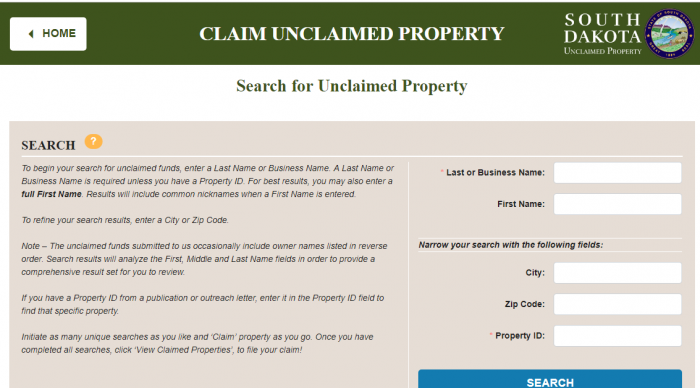 The South Dakota unclaimed money database lets you search using several different parameters: last or business name, first name, city, zip code, and property ID. You can begin a search with a last name or business name. You can add in more details to help narrow down your search.
In order to make our tutorials more helpful for our visitors, we search for property in the same name in each state. We have chosen the name Bob Smith for our searches. The choice of a common name is intentional; because common names can return an unmanageable number of results, we want to make sure you know ways to help narrow down your search results. We start the search by looking for the last name Smith. When we do that, we get the information that the search has returned 1,000 results. This information is actually somewhat misleading; the most results that it will show is 1,000, so we do not know if there are 1,000 results or 10,000 results:
The South Dakota unclaimed money database lets you search using several different parameters: last or business name, first name, city, zip code, and property ID. You can begin a search with a last name or business name. You can add in more details to help narrow down your search.
In order to make our tutorials more helpful for our visitors, we search for property in the same name in each state. We have chosen the name Bob Smith for our searches. The choice of a common name is intentional; because common names can return an unmanageable number of results, we want to make sure you know ways to help narrow down your search results. We start the search by looking for the last name Smith. When we do that, we get the information that the search has returned 1,000 results. This information is actually somewhat misleading; the most results that it will show is 1,000, so we do not know if there are 1,000 results or 10,000 results:
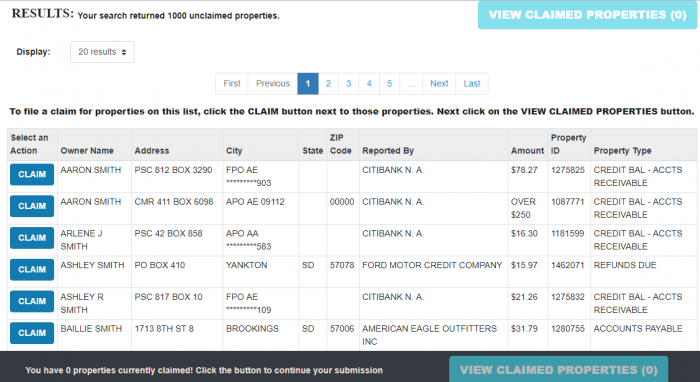 The next step is to narrow down the search by adding in the first name. We then use Bob Smith” in the name search bar instead of just “Smith.” Bob Smith has a number of results in South Dakota, because there are still more than 1,000 results:
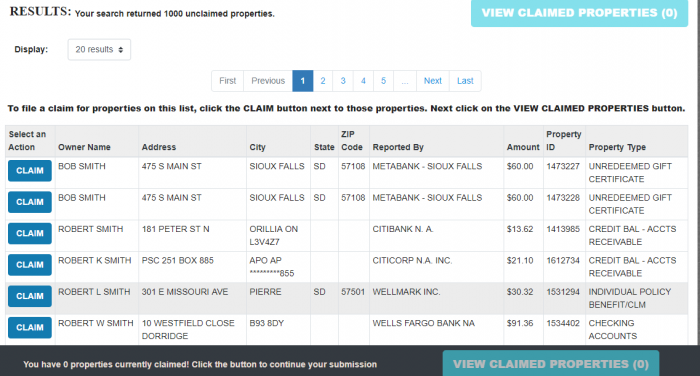 This does not eliminate some of the hits, but it also does not only return results just for Bob Smith. What it does do, however, is place the results for Bob Smith at the top of the results. In addition, it also places names that might frequently be used for Bob, such as Robert, at the top of the search results. Therefore, while it might not reduce your total number of hits, using a full name search helps you tailor your search results.
South Dakota’s database also helps you use some other search parameters. These include the city, zip code, and property ID number. You can really narrow down your search results by adding one of these parameters. For example, we narrowed it down by using the city of Sioux Falls:
This does not eliminate some of the hits, but it also does not only return results just for Bob Smith. What it does do, however, is place the results for Bob Smith at the top of the results. In addition, it also places names that might frequently be used for Bob, such as Robert, at the top of the search results. Therefore, while it might not reduce your total number of hits, using a full name search helps you tailor your search results.
South Dakota’s database also helps you use some other search parameters. These include the city, zip code, and property ID number. You can really narrow down your search results by adding one of these parameters. For example, we narrowed it down by using the city of Sioux Falls:
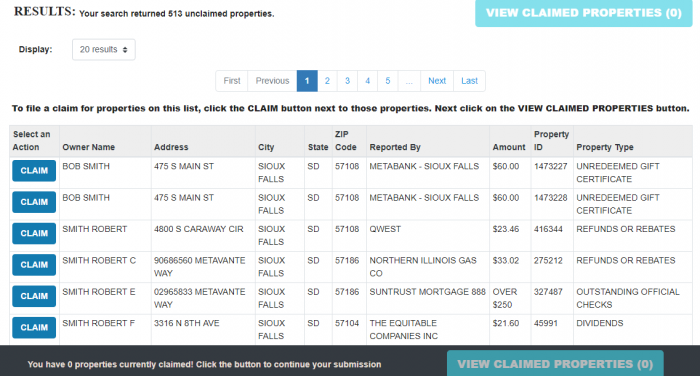 This takes us down to 513 possible results, with the two Bob Smith results in Sioux Falls at the top of the search results.
Looking at each record, you see some information for each record. This information includes the owner name, the owner’s last known address, city state, zip code, who reported the funds, the amount of the claim, the property ID number, and the property type. There is also a claim button on the left side of each property record.
If you want to claim a property, you simply hit the claim button. This will change what you see in the left hand column; instead of seeing the blue claim button, you will see that the property has been claimed and it will give you the option to remove it from your claimed list:
This takes us down to 513 possible results, with the two Bob Smith results in Sioux Falls at the top of the search results.
Looking at each record, you see some information for each record. This information includes the owner name, the owner’s last known address, city state, zip code, who reported the funds, the amount of the claim, the property ID number, and the property type. There is also a claim button on the left side of each property record.
If you want to claim a property, you simply hit the claim button. This will change what you see in the left hand column; instead of seeing the blue claim button, you will see that the property has been claimed and it will give you the option to remove it from your claimed list:
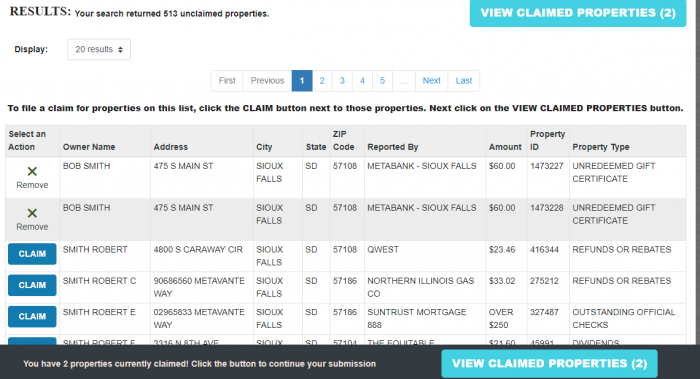 Once you have selected all of the properties you want to claim, you can claim them by hitting the view claimed properties button. There are two, one located on the top right of the screen and one located at the bottom right of the screen. If you hit that button, you are taken to a page that looks like this:
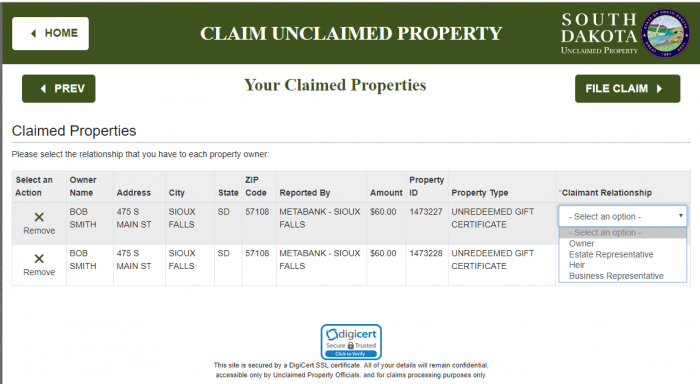
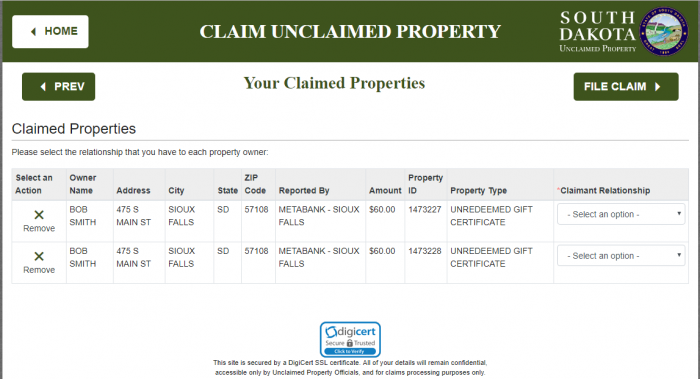 This page provides you a complete list of claimed properties, which you can review before claiming it. For each property, you are given the opportunity to select the claimant relationship. This refers to your relationship to the property owner. Your choices are: owner, estate representative, heir, and business representative:
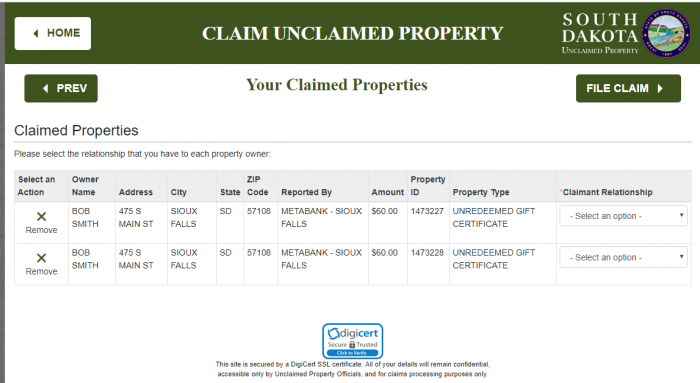
 You have to choose a claimant relationship for each of the properties that you are attempting to claim. Once you have selected your relationship to the property owner for each property you have selected, you can hit the file claim button. There is one located in the top right and in the bottom right of the screen:
 After you hit the file claim button, you will be taken to a page where you fill in your claimant information. The claimant information form asks for your: last name, first name, middle name, date of birth, email address, home phone, social security or tax id number, address, and how you heard about the program:
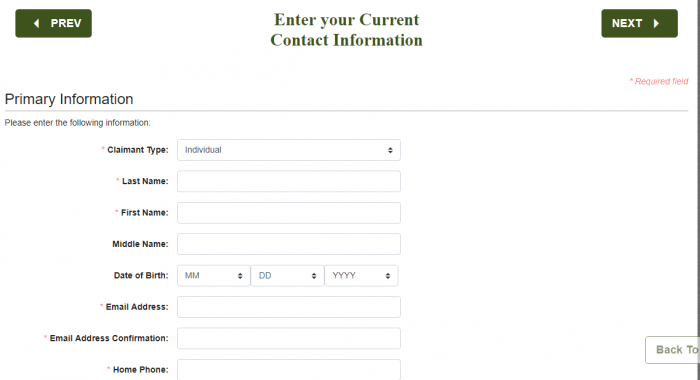 On this information page, you fill in your contact information. Once you have filled in this page, you hit the next button. The screen you see next depends significantly on what type of property you are claiming and the relationship to the claimant that you indicated. The screen will provide you with additional information about what you need to do in order to claim your information; generally, this will mean providing proof of your identity and proof that you resided at the address identified as the last address for the property owner.
Unclaimed Property Laws in South Dakota
South Dakota’s unclaimed property laws are found in South Dakota Codified Laws § 43-41B.South Dakota Unclaimed Money FAQ
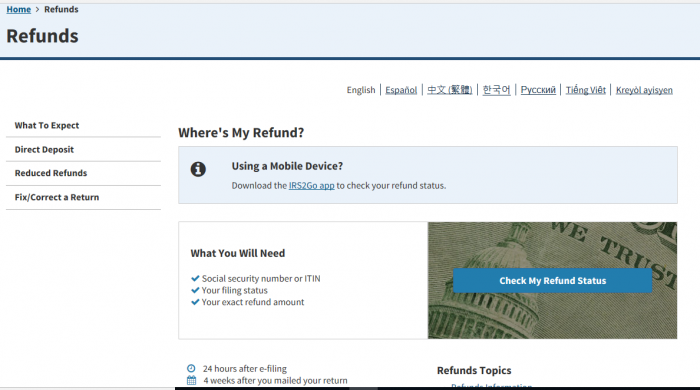
How long does South Dakota hold unclaimed money? South Dakota never takes possession of unclaimed property, but simply takes custody of it. It then holds that property for the property owners indefinitely. Examples of Unclaimed Money Almost any type of abandoned or lost property, except for real property and vehicles, can become unclaimed property. However, the most common types of unclaimed property include: unpaid wages, dividends, uncashed checks, money in savings or checking accounts, stocks, and bonds. In addition, the contents of safe deposit boxes, or at least the proceeds from their sales, often become unclaimed property. Does the state of SD make efforts to locate owners? In addition to operating its unclaimed property database, the state of South Dakota actually runs an extensive outreach program. They use mailings, social media, local media coverage, and advertisements to reach out to owners and to inform people about the unclaimed property program. Other sources to search besides SD state database? One of the biggest mistakes that people can make when they are running an unclaimed property search is to stop with only searching in their state. Even people who have only lived in a single state may need to look in some other states. That is because it is possible that you might have property in a state where you have never resided; for example, someone may have put property in your name or you may have inherited property from someone in another state. All of those states should be on your list of states to search. Another mistake people make is thinking that all unclaimed money escheats to the states. In reality, the federal government does not turn over its unclaimed/abandoned money to the state property lists. In addition, some private businesses, specifically life insurance companies, may not have a state of residence for its property owners, and, therefore, cannot put the money on state unclaimed property lists. Therefore, we think all people searching for unclaimed property need to search the following four sites: the Internal Revenue Service (IRS), the Pension Benefit Guaranty Corporation, the U.S. Treasury, and the Life Insurance Policy Locator. Everyone knows what the IRS is. However, they may not realize that the IRS handles a lot of money that belongs to other people; many, many taxpayers are owed a refund each year. That is why we think every single person who is looking for unclaimed money needs to check with the IRS. In fact, not only does the IRS handle a ton of money for different people, it also has a policy that makes it more likely that this money will not be returned to taxpayers who change their contact information. The IRS has an official policy that they will not forward income tax refund checks if they are returned as undeliverable. You can find out more information on this policy at: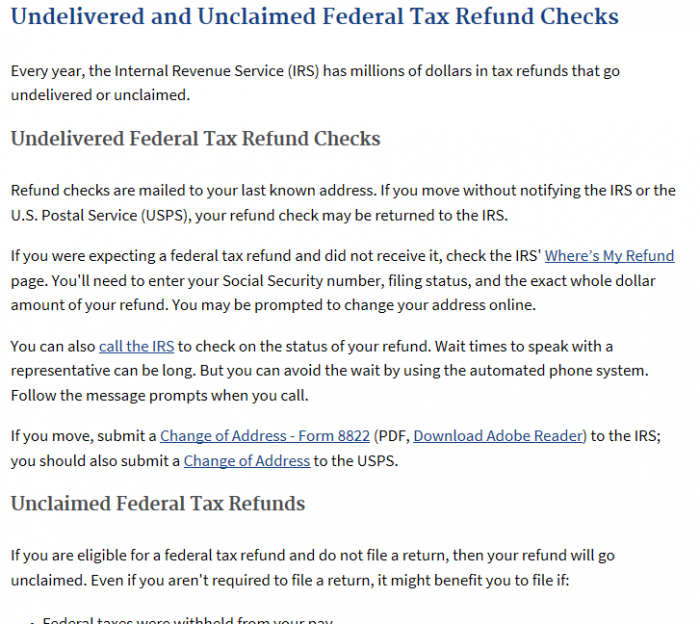 You could even go to the IRS’s Where’s My Refund? page, to help you locate your money:
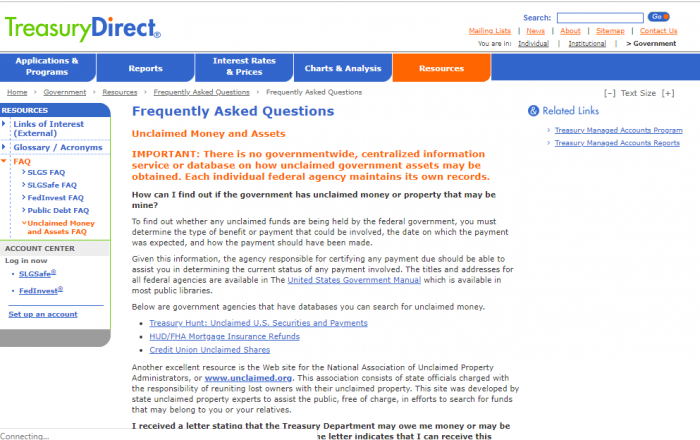
 There are other federal agencies that also handle money for a lot of Americans. The next largest one is probably the U.S. Treasury. The Treasury sells treasury bonds. Moreover, many of these bonds are lost/unclaimed, because they are often bought as gifts for people. Finding those unclaimed bonds is more difficult than it was in the past. While the Treasury used to operate a searchable database that helped you find unclaimed bonds, it discontinued that service. You can still find those bonds; the process is just more difficult. You can get more information on how to find them by calling the U.S. Treasury at 844-284-2676 or visiting the Treasury Direct website.
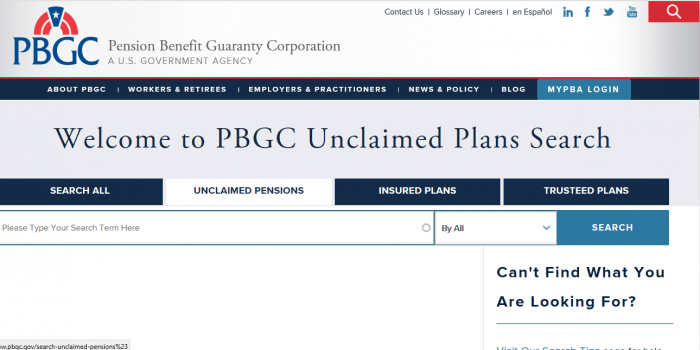
 Not all federal holders of unclaimed money are so obvious. On the contrary, one of the sources is not well known at all. Most people do not realize that the federal government has an organization, Pension Benefit Guaranty Corporation (PBGC), which guarantees pension benefits. The PBGC has a searchable database, where you can look to see if you have any unpaid pension benefits:
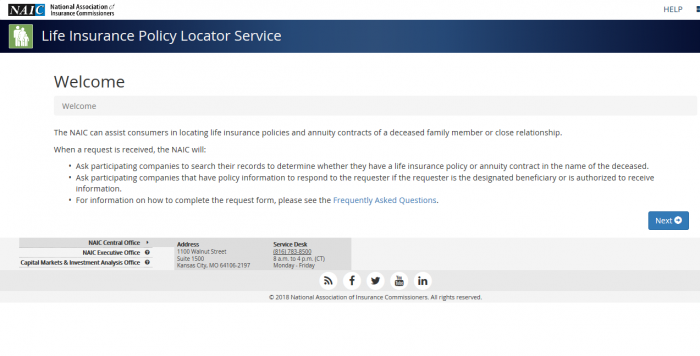
 One of the more complicated areas of unclaimed property searching is looking for insurance benefits, particularly life insurance benefits. A person can name you the beneficiary of a life insurance policy without ever notifying you of that fact. In addition, a person can name you a beneficiary without giving a life insurance company enough information to find and locate you. If the insurance companies do not know where you are located, they do not know to which state database they should report unpaid claims. The National Association of Insurance Commissioners’ Life Insurance Policy Locator Service, and organization that has many (but not all) of the various life insurance companies in the United States among its members, has established a service to help people located unpaid life insurance claims. It does not work the same as state unclaimed property databases; you cannot search their records. Instead, you can input information that the organization will distribute to its member agencies, so that the agencies can search through their records to see if they have any unclaimed policy benefits for you:
 In addition to those four sites, we also suggest that people search some other sites, depending on their circumstances. You may want to look at the following places to see if they have any of your unclaimed funds: the FDIC, the Department of Housing and Urban Development, the National Credit Union Administration, and the Veteran’s Administration Benefits Department.
What is the best way prevent my property from becoming lost or unclaimed?
Keeping your accounts active will keep your property from becoming lost, abandoned, or unclaimed. You also want to make sure that any holders of your property get notified any time you change your contact information, have a name change, or a change in marital status.
How do I make sure my heirs know where my assets are if I die?
A will is not sufficient to make sure your heirs can locate your assets. You need to designate a trusted person to have access to your accounts in the event that you die or become incapacitated.
Should I hire a finder to conduct the search?
South Dakota does not really address the use of finders. There is no fee to search for and file a claim for property. (There may be fees associated with some types of property, such as if you owe outstanding rent on a safe deposit box). Therefore, if you have the time to run a search yourself, you probably do not want to pay a fee to a finder to run the search or process your claims.
Why does South Dakota take possession of unclaimed property?
Like other states, South Dakota takes possession of unclaimed property for two reasons; the first reason is to help owners reclaim their lost property, the second reason is to provide an additional revenue source for the state, because the state can use the funds in the unclaimed property program to generate money for the state.
In addition to those four sites, we also suggest that people search some other sites, depending on their circumstances. You may want to look at the following places to see if they have any of your unclaimed funds: the FDIC, the Department of Housing and Urban Development, the National Credit Union Administration, and the Veteran’s Administration Benefits Department.
What is the best way prevent my property from becoming lost or unclaimed?
Keeping your accounts active will keep your property from becoming lost, abandoned, or unclaimed. You also want to make sure that any holders of your property get notified any time you change your contact information, have a name change, or a change in marital status.
How do I make sure my heirs know where my assets are if I die?
A will is not sufficient to make sure your heirs can locate your assets. You need to designate a trusted person to have access to your accounts in the event that you die or become incapacitated.
Should I hire a finder to conduct the search?
South Dakota does not really address the use of finders. There is no fee to search for and file a claim for property. (There may be fees associated with some types of property, such as if you owe outstanding rent on a safe deposit box). Therefore, if you have the time to run a search yourself, you probably do not want to pay a fee to a finder to run the search or process your claims.
Why does South Dakota take possession of unclaimed property?
Like other states, South Dakota takes possession of unclaimed property for two reasons; the first reason is to help owners reclaim their lost property, the second reason is to provide an additional revenue source for the state, because the state can use the funds in the unclaimed property program to generate money for the state.
Conclusion
South Dakota has millions of dollars in unclaimed property, and 1 in 5 South Dakotans has money in the database. It is time for you to check and see if you are one of them. unclaimed-property-washington-dc Find Any Unclaimed Property in Washington D.C.
Table of Contents
- South Dakota’s Unclaimed Property Database
- What is Unclaimed Property?
- South Dakota’s Unclaimed Money Finder
- Unclaimed Property Laws in South Dakota
- South Dakota Unclaimed Money FAQ
- Conclusion
- Washington D.C. Unclaimed Property Database
- How Much Unclaimed Money in Washington D.C.?
- Washington D.C. Unclaimed Money Finder
- Unclaimed Property Laws in Washington D.C.
- Washington D.C. Unclaimed Money FAQ
- Conclusion
Washington D.C. Unclaimed Property Database
When you search for unclaimed property by state, the state website consolidates information from all of the different counties in the state. The District of Columbia is not divided in counties or territories. Therefore, while it provides information for the entire territory, you will not find information for political subdivisions. Every state and territory has a specific definition of unclaimed money. These definitions are fairly consistent, despite being state-specific. Generally, unclaimed money is money that has been lost or abandoned by the actual owner and is in the possession of a third-party, which is called a holder. Examples of holders include banks, financial institutions, and other businesses. The big difference between the laws has to do with what time periods the states apply before a property can be considered abandoned.How Much Unclaimed Money in Washington D.C.?
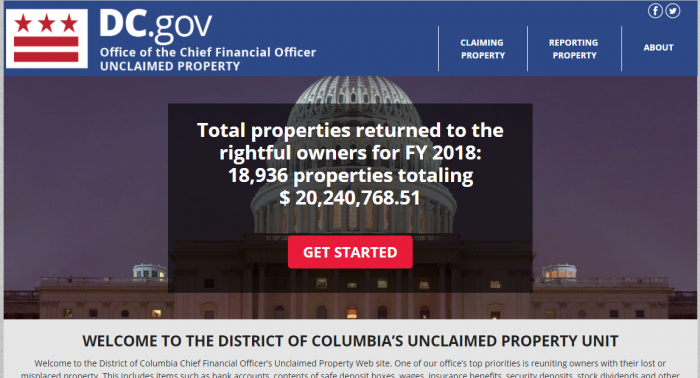
The District of Columbia does not publicize how much missing money is available for potential claimants, a figure that would be constantly changing, anyway, as holders report unclaimed money and property owners make claims for their money. It does, however, state that it has returned over $20 million in unclaimed property to the rightful owners in fiscal year 2018. This is only a small portion of the unclaimed property available in the United States. The National Association of Unclaimed Property Administrators (NAUPA), an organization devoted to helping people locate their unclaimed money, estimates that there is around $42 billion available in unclaimed property available in the United States.Washington D.C. Unclaimed Money Finder
You can access the District of Columbia’s own unclaimed money finder. In addition, the District of Columbia has made its information available at www.MissingMoney.com. If you choose to use the Missing Money website, you can simultaneously search for property in the following states, territories, and provinces: Alabama, Alberta Canada, Arizona, Arkansas, Colorado, District of Columbia, Florida, Idaho, Illinois, Indiana, Iowa, Kentucky, Louisiana, Maine, Maryland, Massachusetts, Michigan, Minnesota, Mississippi, Missouri, Montana, Nebraska, Nevada, New Hampshire, New Jersey, New Mexico, New York, North Carolina, North Dakota, Ohio, Oklahoma, Puerto Rico, Rhode Island, South Carolina, South Dakota, Tennessee, Texas, Utah, Vermont, Virginia, West Virginia, and Wisconsin. For the purposes of this tutorial, we are running the search from the District of Columbia’s unclaimed property page: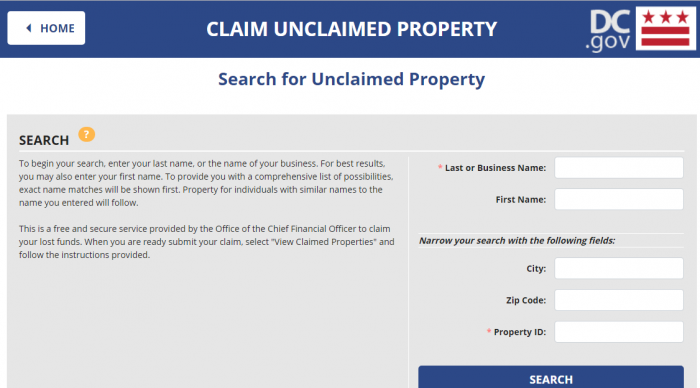 To start your search, you are asked to provide your last name or a business name. You may also add some additional qualifiers to help you narrow your search. These include your first name, the city, the zip code, and a property ID number.
We try to remain consistent across our tutorials, so that you can easily apply what you have learned in one tutorial to a search in a different state or territory. For that reason, we use the same name, Bob Smith, for all of our tutorials. Not only does this provide consistency, but the use of a common name lets us show you how to handle it when your search returns too many potential results. f there will be so many results for your search that it is impossible to go through all of them.
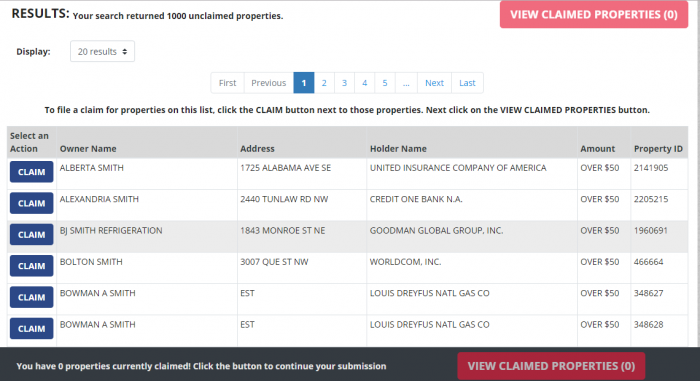
In the District of Columbia, your search can turn up a maximum of 1,000 results. When we look at the results just searching for the last name Smith, we see that we get at least 1,000 results and that we do not see all of the potential results:
To start your search, you are asked to provide your last name or a business name. You may also add some additional qualifiers to help you narrow your search. These include your first name, the city, the zip code, and a property ID number.
We try to remain consistent across our tutorials, so that you can easily apply what you have learned in one tutorial to a search in a different state or territory. For that reason, we use the same name, Bob Smith, for all of our tutorials. Not only does this provide consistency, but the use of a common name lets us show you how to handle it when your search returns too many potential results. f there will be so many results for your search that it is impossible to go through all of them.
In the District of Columbia, your search can turn up a maximum of 1,000 results. When we look at the results just searching for the last name Smith, we see that we get at least 1,000 results and that we do not see all of the potential results:
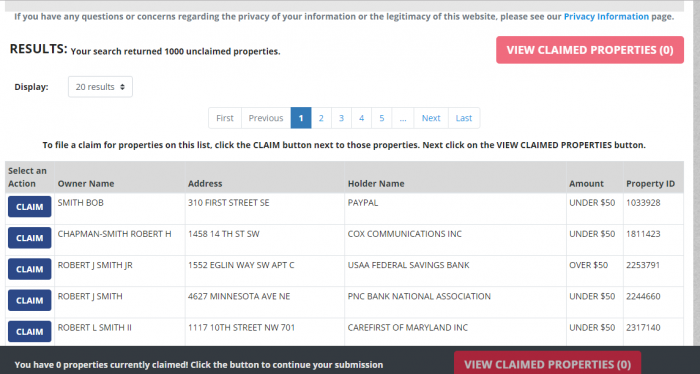
 The easiest way to narrow down search results is by looking for the first name with the last name. Depending on where you are searching, this can really result in a significant difference for your search results. However, in D.C., it does not really make a difference. There are still at least 1,000 results:
 Normally, if we had this many results for a simple first and last name search, we would narrow down the results by adding a city name. In the District of Columbia, there is only one city name, so that is not going to help narrow down our results. Instead, we can try to further narrow the search by adding a zip code to the search. We chose to use 20001. That narrowed the results down from over 1,000 to 443. While this is still not an ideal number of results, it does make the search more manageable:
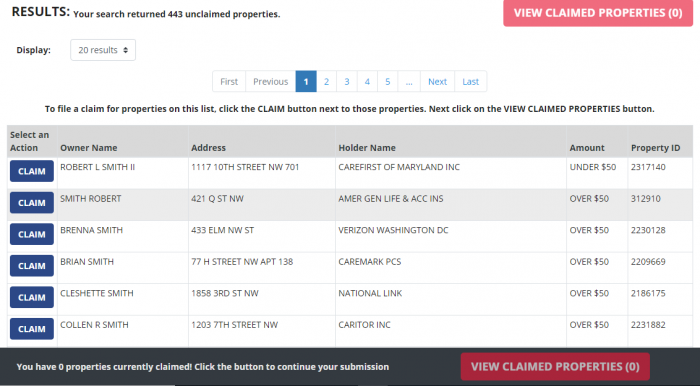 While 443 may still seem like an unmanageable number of hits, looking at the results reveals that the results include other Smith results besides Bob. In fact, there are no Bob results. If there were, they would be at the top of the search results. There are two Robert Smith results. Therefore, this has resulted in the search results being manageable.
Once you have your desired search results, you can look at the property description. These are fairly uniform across the different searches for all of the various states. You find a claim button on the left, the property owner’s name, the property owner’s last known address, the name of the holder, the amount of the property, and the property ID number.
To claim the property, you will hit the blue “claim” button that is on the left. When you do, you will notice that the claim button disappears, and you get an option to “remove” the claim instead:
While 443 may still seem like an unmanageable number of hits, looking at the results reveals that the results include other Smith results besides Bob. In fact, there are no Bob results. If there were, they would be at the top of the search results. There are two Robert Smith results. Therefore, this has resulted in the search results being manageable.
Once you have your desired search results, you can look at the property description. These are fairly uniform across the different searches for all of the various states. You find a claim button on the left, the property owner’s name, the property owner’s last known address, the name of the holder, the amount of the property, and the property ID number.
To claim the property, you will hit the blue “claim” button that is on the left. When you do, you will notice that the claim button disappears, and you get an option to “remove” the claim instead:
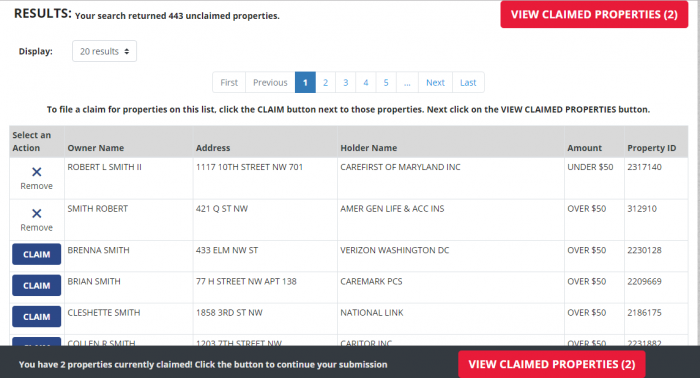 If you have mistakenly added a property or want to remove a property for any reason, you would just hit the blue remove button to have the property removed from your claimed property list.
After you have found every property that you want to claim, you can look over your properties by going to the “view claimed properties” button located on the top right of the page. You will find another button located on the bottom right of the page. After you have claimed the properties, you will see a page that looks like this:
If you have mistakenly added a property or want to remove a property for any reason, you would just hit the blue remove button to have the property removed from your claimed property list.
After you have found every property that you want to claim, you can look over your properties by going to the “view claimed properties” button located on the top right of the page. You will find another button located on the bottom right of the page. After you have claimed the properties, you will see a page that looks like this:
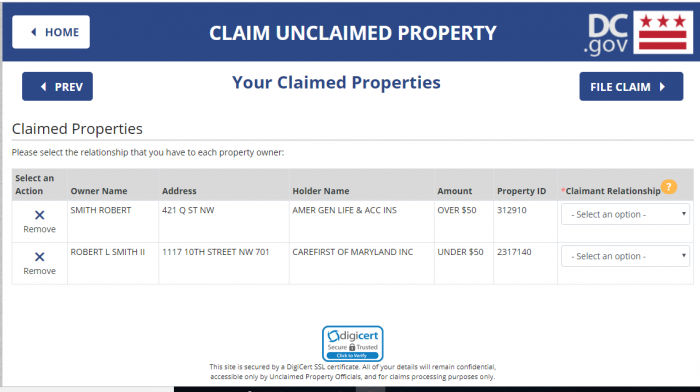 You will notice that you are asked to identify your relationship to the claimant in order to claim the properties. The options you have include: owner, estate representative, heir, or business. Choose the appropriate relationship for each claim:
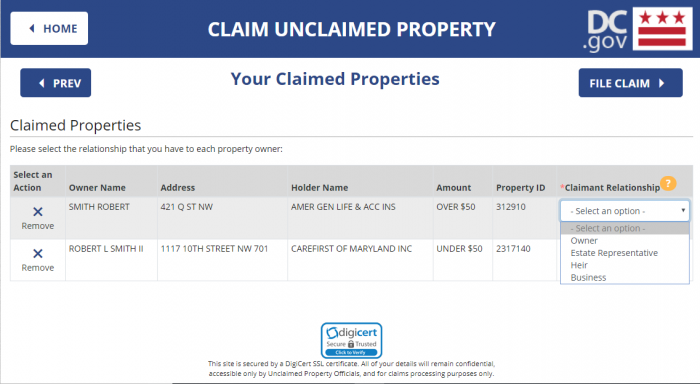 If you want to claim all of the properties, you can proceed to the file claim button, which is located on the top right of the page. Doing so takes you a claimant information page, where you are asked to include information such as your first name, last name, address, postal code, city, province or state, country, email, and phone number:
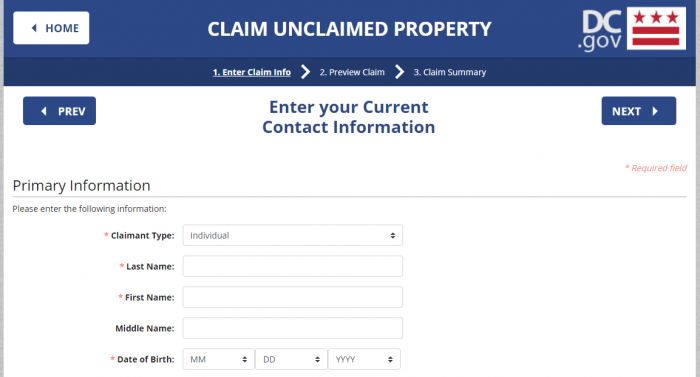 After you have filled in the claim information form, you will receive a notification of what type of proof you need to provide in order to proceed with your claim. Generally, you will at least be asked to provide proof of your identity, as well as proof that you resided at the address listed on the claim.
Unclaimed Property Laws in Washington D.C.
The District of Columbia’s Unclaimed Property Law is located in DC ST41-101.Washington D.C. Unclaimed Money FAQ
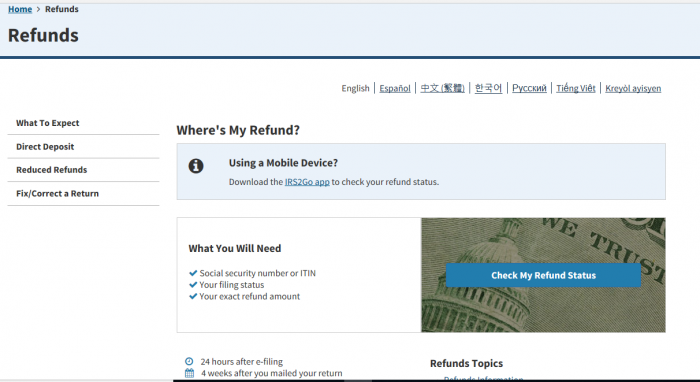
How long does the District of Columbia hold unclaimed property? The District of Columbia will hold money indefinitely for the rightful owner. Examples of Unclaimed Property Almost any type of personal property can be unclaimed property, though two major exceptions are real property and motor vehicles. Frequent examples of unclaimed property include money in bank accounts, stocks, bonds, uncashed checks, unpaid wages, and items in safety deposit boxes. Does DC make efforts to locate owners? The District of Columbia does not have the same outreach efforts that you find in many states, but it does make unclaimed money searchable on its database and it does participate in the Missing Money database. Other sources to search besides the DC unclaimed property database? One of the biggest mistakes that people can make is starting and ending their unclaimed property search in the same location. Many people only look in the state or territory where they reside. However, for most people, the unclaimed property search process should be more involved. You may need to look in additional states or territories, and you probably need to include some national sites in your search. When making a list of states you should search, think about any state where you have lived, any state where you may have established business contacts, and any state where someone may have put money in your name. The District of Columbia is on the Missing Money website, so you may be able to search multiple states or territories simultaneously. In addition to looking at states and territories, you may also need to look at some national sites. That is because some money never escheats to the state, but states in federal level sites. Even in the District of Columbia, despite it being a national territory, you would have to look at the national site to find that missing property. The four sites we suggest most people include in their unclaimed property search are: the Internal Revenue Service (IRS), the Pension Benefit Guaranty Corporation, the U.S. Treasury, and the Life Insurance Policy Locator. The IRS processes more individual’s money than any other holder in the United States. However, it has a policy of not forwarding income tax refunds if a person has changed address after filing their income taxes. You can read more about this policy on the IRS’s website: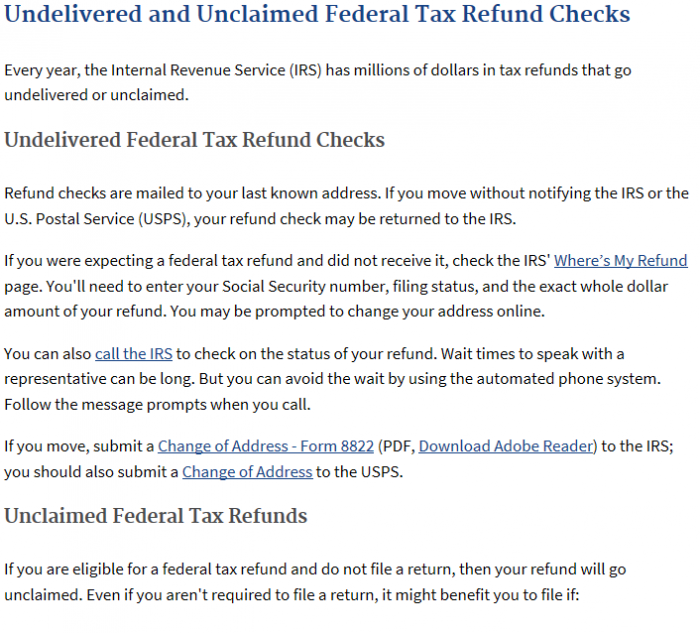 Fortunately, if you think you should have received an income tax refund, but have not received it, you can head to the IRS’s Where’s My Refund? page to locate it:
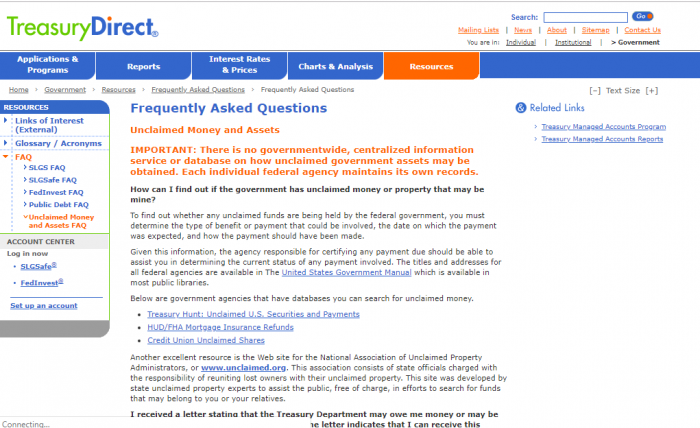
 The IRS is not the only major holder in the federal government. The U.S. Treasury also holds a huge amount of money for Americans. Unlike taxes, you may not even realize that the Treasury ever held money for you, because many people purchase U.S. Savings bonds as gifts for other people. Unfortunately, the Treasury recently discontinued its easy to use searchable database. Now, if you want to track down missing bonds, you need to contact the U.S. Treasury for more information. You can call them at 844-284-2676 or visit them online at the Treasury Direct website:
 A third government agency that might be able to help you find your unclaimed money is the Pension Benefit Guaranty Corporation (PBGC), which is a government-run corporation that guarantees private pension benefits. The PBGC operates a searchable database that helps people locate missing pension benefits:
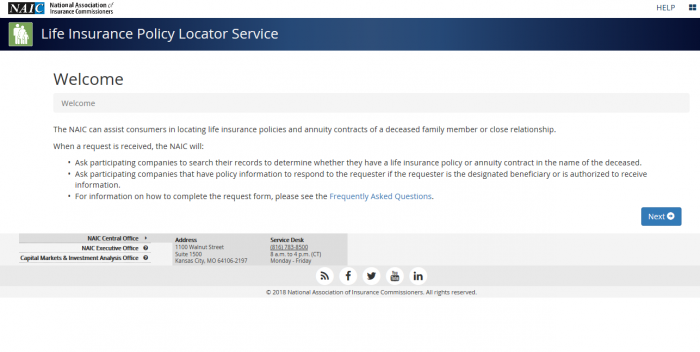
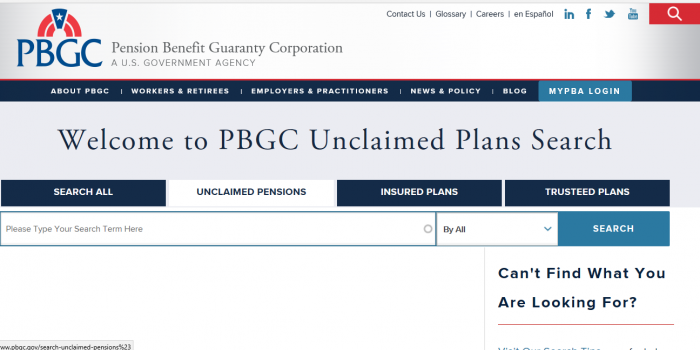 The fourth site we suggest you search is not a government site, but does operate on a national level. It is a service of a national conglomeration of life insurance companies known as the National Association of Insurance Commissioners’ Life Insurance Policy Locator Service. While this service does not provide a searchable database, it does allow you to put your information into their system. It then distributes that information to its member agencies, which check their records to see if you are the beneficiary of any unpaid insurance policies:
 While not everyone needs to look at some additional federal sites, there are several other federal-level holders of money. Depending on your history, you may want to look for unclaimed money at: the FDIC, the Department of Housing and Urban Development, the National Credit Union Administration, and the Veteran’s Administration Benefits Department.
What is the best way prevent my property from becoming lost or unclaimed?
The best way to prevent property from being considered lost or unclaimed is to keep in regular contact with your financial institutions. To do this, it helps to keep detailed account records and set up reminders to contact your holders on a yearly basis. In addition, use electronic account management when it is available.
How do I make sure my heirs know where my assets are if I die?
You need to appoint a trusted individual to access your financial records if you die or are incapacitated, and leave that individual information on how to do so. A will does not tell your heirs how to locate your assets.
Should I hire a finder to conduct the search?
The District of Columbia encourages people to check their website before hiring a finder service, because finder services can result in you being charged significant fees, while the process of searching for and claiming unclaimed property is free in the District of Columbia.
Why does DC take possession of unclaimed property?
As with other states and territories, DC takes possession of unclaimed property for two reasons. The first reason is consumer protections; consolidating unclaimed property into a single database makes it more likely that the property will be recovered. The second reason is economic; by taking possession of unclaimed property, the District can use it to create revenue until it is claimed by its rightful owner.
While not everyone needs to look at some additional federal sites, there are several other federal-level holders of money. Depending on your history, you may want to look for unclaimed money at: the FDIC, the Department of Housing and Urban Development, the National Credit Union Administration, and the Veteran’s Administration Benefits Department.
What is the best way prevent my property from becoming lost or unclaimed?
The best way to prevent property from being considered lost or unclaimed is to keep in regular contact with your financial institutions. To do this, it helps to keep detailed account records and set up reminders to contact your holders on a yearly basis. In addition, use electronic account management when it is available.
How do I make sure my heirs know where my assets are if I die?
You need to appoint a trusted individual to access your financial records if you die or are incapacitated, and leave that individual information on how to do so. A will does not tell your heirs how to locate your assets.
Should I hire a finder to conduct the search?
The District of Columbia encourages people to check their website before hiring a finder service, because finder services can result in you being charged significant fees, while the process of searching for and claiming unclaimed property is free in the District of Columbia.
Why does DC take possession of unclaimed property?
As with other states and territories, DC takes possession of unclaimed property for two reasons. The first reason is consumer protections; consolidating unclaimed property into a single database makes it more likely that the property will be recovered. The second reason is economic; by taking possession of unclaimed property, the District can use it to create revenue until it is claimed by its rightful owner.
Conclusion
The District of Columbia has a surprising amount of unclaimed property, probably because it has a frequently-changing population. It is one of those territories that many people will want to include in their property searches.Search Unclaimed Money in Other States
Looking for unclaimed money in a different state? Browse all 50 states below to find unclaimed property in your area.
ALAlabamaAKAlaskaAZArizonaARArkansasCACaliforniaCOColoradoCTConnecticutDEDelawareFLFloridaGAGeorgiaHIHawaiiIDIdahoILIllinoisINIndianaIAIowaKSKansasKYKentuckyLALouisianaMEMaineMDMarylandMAMassachusettsMIMichiganMNMinnesotaMSMississippiMOMissouriMTMontanaNENebraskaNVNevadaNHNew HampshireNJNew JerseyNMNew MexicoNYNew YorkNCNorth CarolinaNDNorth DakotaOHOhioOKOklahomaOROregonPAPennsylvaniaRIRhode IslandSCSouth CarolinaTNTennesseeTXTexasUTUtahVTVermontVAVirginiaWAWashingtonWVWest VirginiaWIWisconsinWYWyoming