📋 Table of Contents
▼

Table of Contents
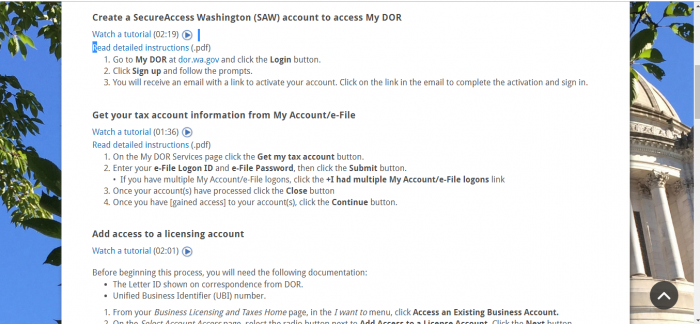
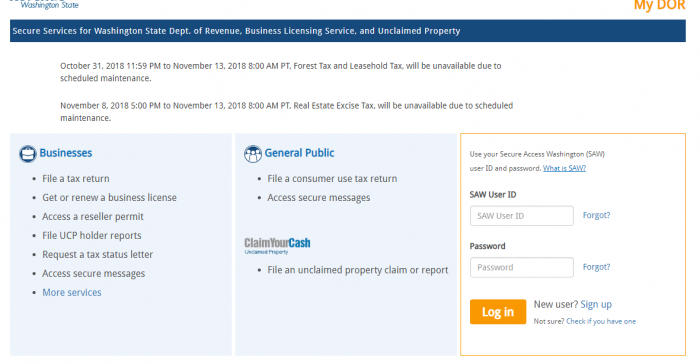
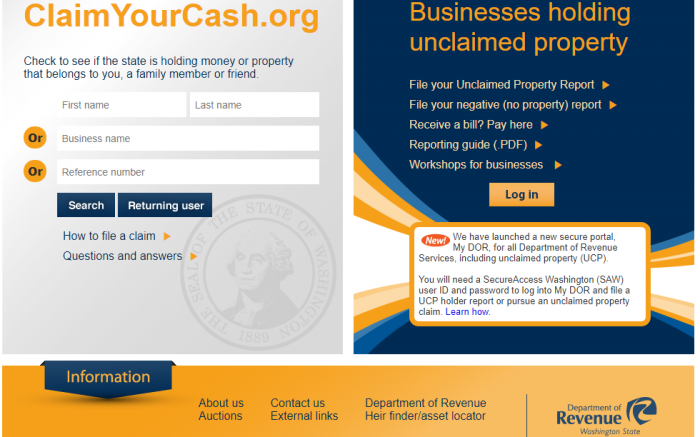 However, something new to the site is that, in order to claim your unclaimed property, you must sign up for a SecureAccess Washington user ID and password. You may already have an account if you have used SecureAccess for your Washington taxes. If not, you need to follow the steps below in order to set up an account:
 When most people begin the unclaimed money search process, they fall victim to a common error: only looking in the state where they live. While the state where you live is the right place to start an unclaimed property search, it is only a jumping off point. Even if you have only ever lived in the state of Washington, a complete unclaimed property search may require you to look in some other places. For example, property is held in the state with the last known address of the holder. If you have an employer or an insurer who is headquartered in another state, and who cannot find a known address for you, your property might actually be held in that state. In addition, there are some types of property that simply never escheat to the state. Federal income tax returns and U.S. Savings bonds both fall into that category, which means you need to check federal databases in addition to state databases.
When people find out that they need to look at multiple sources, they can find the process for the search to be overwhelming. While it is true that a complete asset search can involve multiple steps, states have done their best to make the steps for searching and claiming property a simple process. For U.S. residents, the process is as easy as it can be, since all states and most territorial U.S. governments, as well as the federal government have easy search tools that help you find your property, as well as detailed instructions for how to claim the property. While we cannot tell you the process will be quick, we can tell you that it is easier than you think.
When most people begin the unclaimed money search process, they fall victim to a common error: only looking in the state where they live. While the state where you live is the right place to start an unclaimed property search, it is only a jumping off point. Even if you have only ever lived in the state of Washington, a complete unclaimed property search may require you to look in some other places. For example, property is held in the state with the last known address of the holder. If you have an employer or an insurer who is headquartered in another state, and who cannot find a known address for you, your property might actually be held in that state. In addition, there are some types of property that simply never escheat to the state. Federal income tax returns and U.S. Savings bonds both fall into that category, which means you need to check federal databases in addition to state databases.
When people find out that they need to look at multiple sources, they can find the process for the search to be overwhelming. While it is true that a complete asset search can involve multiple steps, states have done their best to make the steps for searching and claiming property a simple process. For U.S. residents, the process is as easy as it can be, since all states and most territorial U.S. governments, as well as the federal government have easy search tools that help you find your property, as well as detailed instructions for how to claim the property. While we cannot tell you the process will be quick, we can tell you that it is easier than you think.
What is Unclaimed Money?
Unclaimed money goes by a few different names, including unclaimed money, unclaimed property, abandoned money, and abandoned property. Generally, the term refers to property that you have abandoned and which has an identifiable monetary value. Abandoned property does not mean that you had to have had an intent to leave the property, but simply that you placed the property with a financial institution or other third-party holder, and then lost contact with that holder. Each state has its own specific laws determining what constitutes unclaimed property, and these laws are different depending on the type of property in question and the type of owner. What they have in common is that they all require that a statutory period where the holder is unable to contact the property owner must elapse before the property is sent to the state. In Washington, the abandoned property law is Washington Revised Code Chpt. 63.29: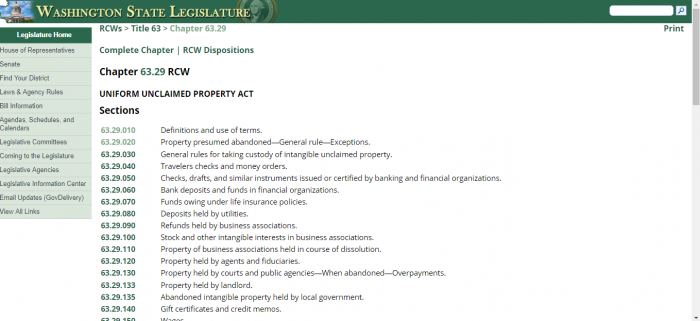
How Much Unclaimed Money is in Washington?
While unclaimed property amounts are constantly fluctuating, since the beginning of the unclaimed property program in 1955, the State of Washington has received more than $1 billion in unclaimed assets. However, keep in mind that the unclaimed money in Washington may not reflect all of the unclaimed money that is due to people who live in Washington, as you may have unclaimed assets in other states or being held by the federal government. When you look at the total picture, the amount of unclaimed money is staggering. The National Association of Unclaimed Property Administrators (NAUPA) is a nationwide organization devoted to caring for unclaimed property. While the amounts are constantly fluctuating as new property is added and other property is claimed, NAUPA estimates that there is currently about $42 billion in unclaimed property in the United States.Washington Unclaimed Money Finder
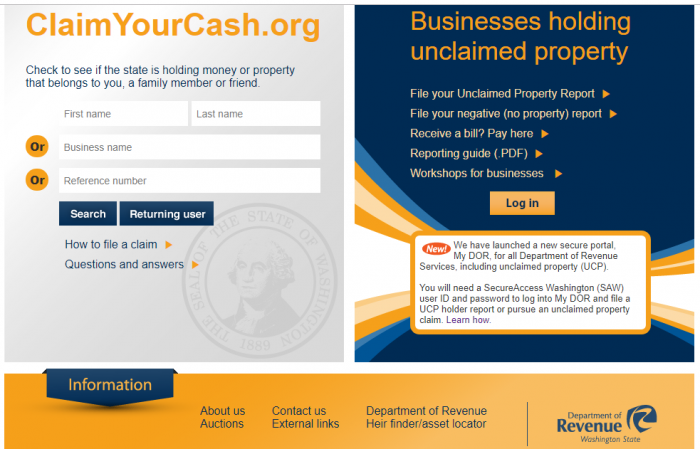
Washington operates an unclaimed money finder at www.claimyourcash.org.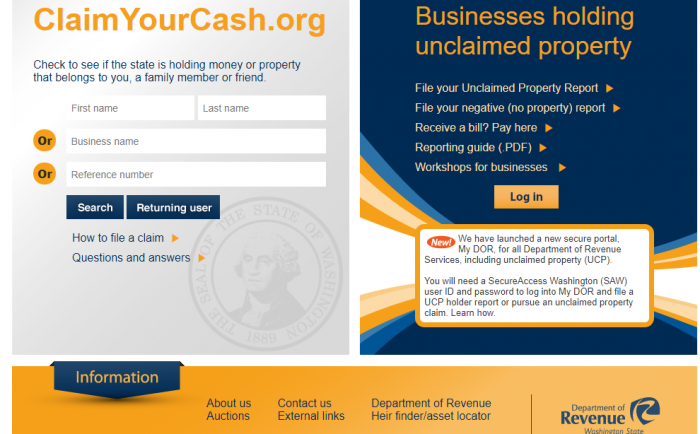 The state database has information for all of Washington’s 39 counties, including: Adams, Asotin, Benton, Chelan, Clallam, Clark, Columbia, Cowlitz, Douglas, Ferry, Franklin, Garfield, Grant, Grays Harbor, Island, Jefferson, King, Kitsap, Kittitas, Klickitat, Lewis, Lincoln, Mason, Okanogan, Pacific, Pend Oreille, Pierce, San Juan, Skagit, Skamania, Snohomish, Spokane, Stevens, Thurston, Wahkiakum, Walla Walla, Whatcom, Whitman, and Yakima.
To begin your search, you need your first name, last name, business name, or reference number.
The state database has information for all of Washington’s 39 counties, including: Adams, Asotin, Benton, Chelan, Clallam, Clark, Columbia, Cowlitz, Douglas, Ferry, Franklin, Garfield, Grant, Grays Harbor, Island, Jefferson, King, Kitsap, Kittitas, Klickitat, Lewis, Lincoln, Mason, Okanogan, Pacific, Pend Oreille, Pierce, San Juan, Skagit, Skamania, Snohomish, Spokane, Stevens, Thurston, Wahkiakum, Walla Walla, Whatcom, Whitman, and Yakima.
To begin your search, you need your first name, last name, business name, or reference number.
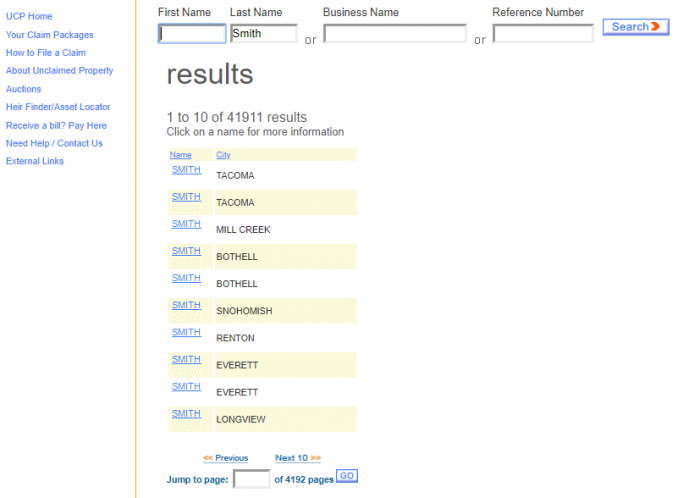
 You can run a last-name only search, which can be convenient if you do not know whether you used your first name, an initial, a middle name, or a nickname. It can also be helpful if you are searching for other family members’ property at the same time as your search. However, if you have a fairly common last name, you are going to get so many results that your search is unworkable. For example, looking for Smith on 10/25/2018 yielded 41, 911 results! Fortunately, each name lists a city of last known residence by it, which may help you narrow your search:
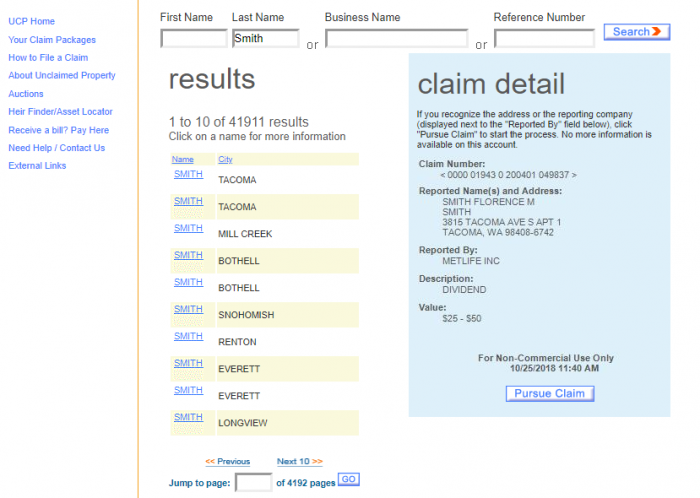
 If you select a claim that you believe is yours, it pulls up more detailed claim information. If you believe that the claim is yours, you can hit the “pursue your claim” button to begin the process of filing your claim:
 To proceed with pursuing a claim, you must sign up through the SecureAccess Portal offered by the DOR:
 Once you have signed up for your SAW, pursuing your claim is relatively simple. Simply follow the instructions on the screen to submit an electronic claim, or you can choose to print a claim and mail the voucher to the office. Either way, you will be asked to attach proof to your claim. You can scan your proof items, but if you do not have a scanner, you can still use the electronic filing system. Simply make sure and choose the mail-in option when you are asked to submit your proof. Each claim voucher will tell you exactly the items needed to prove your claim.
Unclaimed Money Laws in Washington
In Washington, the abandoned property law is based on the Uniform Code and can be found at Washington Revised Code Chpt. 63.29: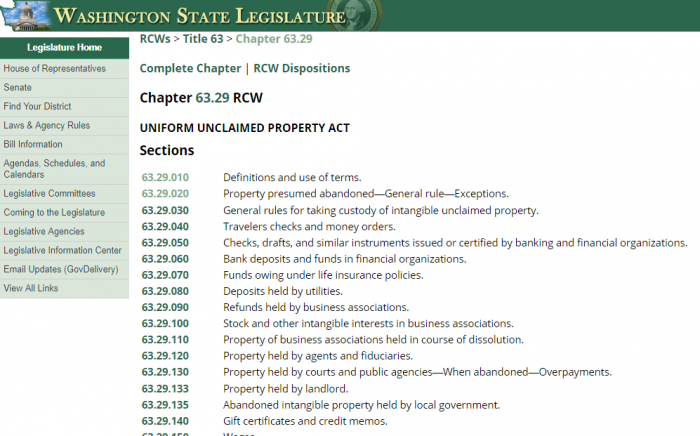
Washing Unclaimed Money FAQ
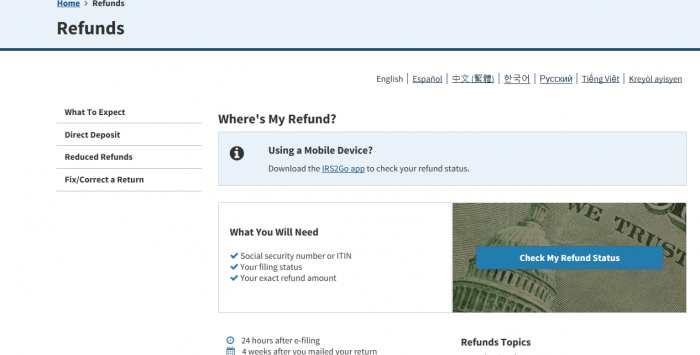
How long does Washington hold unclaimed money? The State of Washington Department of Revenue will hold property received since 1955 indefinitely, with the exception of safe deposit box contents, which will be auctioned after five years. The proceeds from the auctions will be held for the original owners. Examples of Unclaimed Money There are various types of property that can be classified as unclaimed property or money. Almost any type of property that an owner gives to a third-party holder for safekeeping can be classified as unclaimed property, though contractual relationships between the parties can keep the property from ever being classified as unclaimed. The types of contracts that usually result in property reverting to the ownership of the owner include storage rental contracts, housing rental contracts, and contracts at pawn shops. Examples of the type of property that ends up in the unclaimed fund includes: savings and checking accounts, investments and dividends, securities, utility and other deposits, refunds from vendors, unpaid wages or uncashed paychecks, insurance policy money, outstanding checks, and safe deposit box contents. Not all items in safe deposit boxes will end up as unclaimed property, because unclaimed property has to have a monetary value. Does state of WA make efforts to locate owners? Yes. Washington attempts to locate owners and send them notifications of unclaimed property. Other sources to search besides WA state database? Even if you have only ever resided in Washington, you may need to check other state databases for unclaimed property. Rather than just assuming you only need to look at Washington, we recommend that you sit down and think about any other locations which might have your unclaimed property. Which states could be holding unclaimed property for you? Include any state where you lived, even if you were not an adult when you lived there. Think about states where relatives lived, especially when you were a child. Would a grandparent, aunt, uncle, or god parent have opened an account for you in a different state? Next, think about states where you might have business contacts. Sometimes an employer or an insurer is headquartered out of state, and there is a possibility, albeit a small one, that state has unclaimed property for you. Even if you do not have contacts with other states, there are sites other than the Washington site that you need to check. These are federal sites, though two of them are not operated by the government, and have property that either does not escheat to the states or may not be reported to the states. The sites are: the U.S. Treasury, the IRS, the National Pension Benefit Guaranty Corporation, and the Life Insurance Policy Locator Service. The U.S. Treasury is one of the biggest holders of unclaimed property in the United States; in fact, it has over $17 billion in unclaimed savings bonds. In the past, it tried to simplify the process of connecting people with their unclaimed property. However, it inexplicably decided to stop its user-friendly unclaimed property database. You can still find information about how to claim unclaimed savings bonds on its Treasury Direct website, by contacting them at 844-284-2676, or by writing to the Bureau of Public Debt. Another significant source for unclaimed property is the Internal Revenue Service. The IRS does not forward tax refund checks, nor do those funds escheat to the state. Since almost all people pay taxes or are related to people who pay taxes, the IRS is a much-search site for anyone looking for unclaimed property!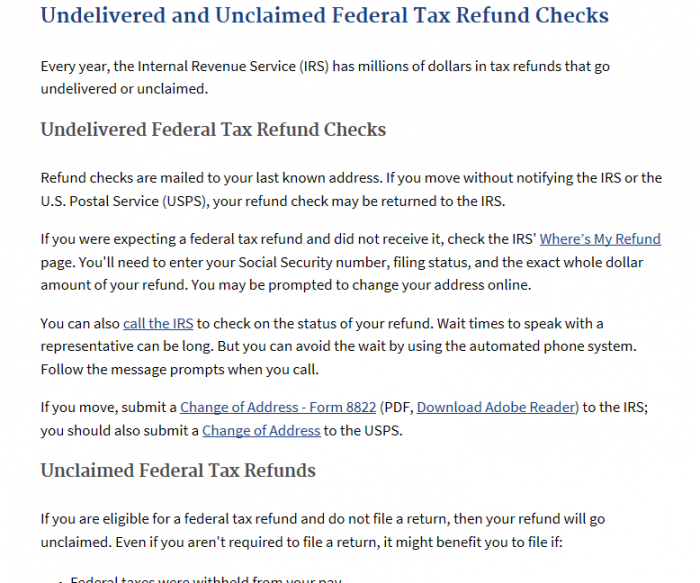 If you are going to the IRS page because you believe that you have a refund due to you, but you have not received it, you can easily check for that refund on its Where’s My Refund? page:
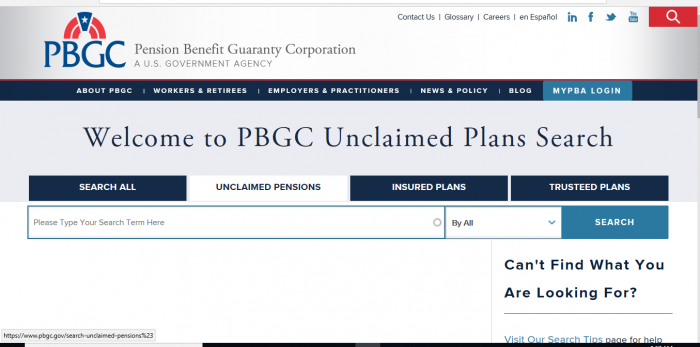
 Another invaluable resource for finding unclaimed property is the Pension Benefit Guaranty Corporation website. Although pensions are not paid by the federal government, they are guaranteed by the federal government, and the PBGC has a database where it hopes to connect over 70,000 potential claimants with over $400 million in unclaimed pension benefits.
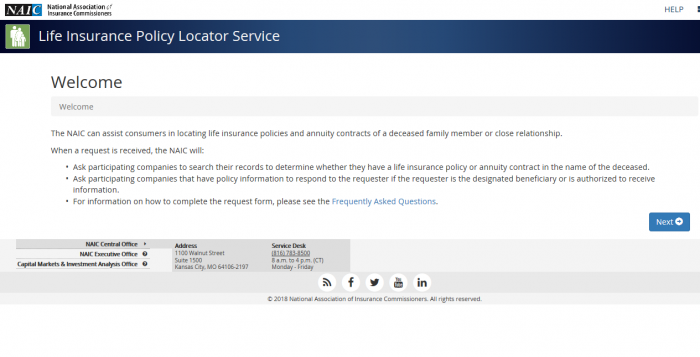
 Another place that it does not hurt to check is the National Association of Insurance Commissioners’ Life Insurance Policy Locator Service. Unpaid life insurance proceeds may or may not be in state databases, depending on whether the insurer has any location information for beneficiaries, which can make searching in a national clearinghouse especially important for these types of funds. They do not offer an unclaimed property database that allows users to search to see if they are beneficiaries of unclaimed policies. However, they do allow you to input your information, then they distribute that information to member agencies, which look to see if you match any of their beneficiaries. The process is not difficult, but it does not provide the same instantaneous results as other search methods.
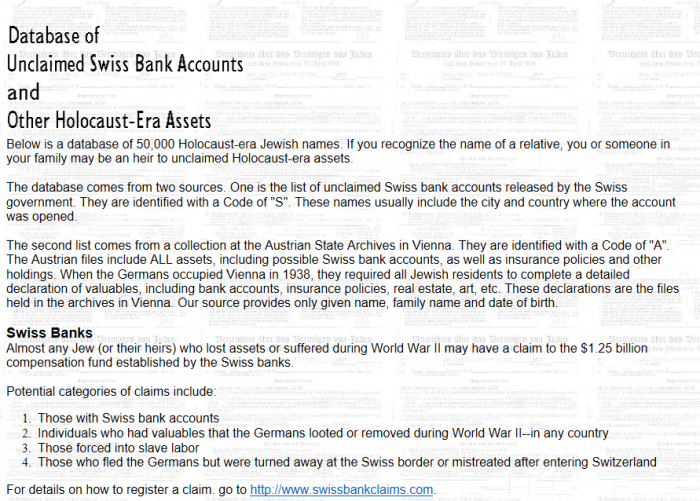
 Once you have compiled your list of state and federal resources to search for unclaimed property, take a few moments to think outside of the box. There are some groups established to help people who may have been victimized, where that victimization could have led to the misappropriation of property. Probably the best known of these groups is composed of people targeted in the Holocaust. If you or your ancestors fall into that group, we strongly suggest checking the Holocaust Survivors and Victims Database. While that property is really stolen property, not abandoned property, we think it should be included in any unclaimed property search.
 How do I make sure my heirs know where my assets are if I die?
A will is not enough to make sure that your heirs get your assets. While a will tells people how you want your assets distributed, it does not tell them where to find the assets in the first place. That is why it is critical that you designate at least one trusted individual as a safe keeper of your detailed financial information, and either provide them access to that information during your lifetime or with instructions on how to access that information upon your death. Do not forget to leave them keys and address information for any safety deposit boxes, storage units, or other rental properties where you may be storing property.
How can I prevent my property from becoming lost or unclaimed?
Most abandoned property is not really abandoned, it is actually forgotten. People move and forget to update their address information with the holder of their property, and eventually forget about that property. There are steps you can take to prevent that from occurring. First, in this day and age, almost every holder will give you the option of electronic records. Sign up with a non-work email address and use that address for all of your financial records. Even if you move, change your name, or change your phone number, you will still have access to your financial records.
Second, create a file with all of your detailed financial records. For every single account, make sure and include the following information: the name of the financial institution or other holder; the name you used to open the account; the account numbers; the date you opened the account; when deposits are due back to you; the amount of the account of deposit; the physical address of the holder; and phone numbers for the holder. If the property is physical property held in a physical location, such as a storage unit or safety deposit box, include the address and other identifying information, and a key to the unit.
Should I hire a finder to conduct the search?
This is probably the number one question we get from people. Unfortunately, we do not have an easy yes-or-no answer to that question. There is absolutely nothing wrong with using a legitimate finder service. The people who are against finder services point out that you can run the exact same searches that a finder service will run, by yourself, for free, and not have to pay any fees to collect your money. That is absolutely true. It also ignores the fact that running your own search and filing your own claims can be time-consuming, and that people may put off running their own searches indefinitely because of a lack of time. If you are one of those people, then you have to ask yourself whether ending up with 70 to 80% of your unclaimed assets is better than ending up with none of them.
That said, as with any service where a third-party will have access to your personal information, you must be very wary of fraud when using a finder service. A finder service must get your identifying information, and often copies of your personal documents, in order to run the search and complete the claim process. Only use reputable services and never respond to an unsolicited offer to use a service.
Why does Washington take possession of unclaimed property?
Like other states, Washington takes possession of unclaimed property for two reasons. The first is to help actual owners locate and claim their forgotten, lost, or abandoned property. The second reason is that doing so provides revenue to the state, which is able to use the money to make more money until the property is claimed by the original owner.
How do I make sure my heirs know where my assets are if I die?
A will is not enough to make sure that your heirs get your assets. While a will tells people how you want your assets distributed, it does not tell them where to find the assets in the first place. That is why it is critical that you designate at least one trusted individual as a safe keeper of your detailed financial information, and either provide them access to that information during your lifetime or with instructions on how to access that information upon your death. Do not forget to leave them keys and address information for any safety deposit boxes, storage units, or other rental properties where you may be storing property.
How can I prevent my property from becoming lost or unclaimed?
Most abandoned property is not really abandoned, it is actually forgotten. People move and forget to update their address information with the holder of their property, and eventually forget about that property. There are steps you can take to prevent that from occurring. First, in this day and age, almost every holder will give you the option of electronic records. Sign up with a non-work email address and use that address for all of your financial records. Even if you move, change your name, or change your phone number, you will still have access to your financial records.
Second, create a file with all of your detailed financial records. For every single account, make sure and include the following information: the name of the financial institution or other holder; the name you used to open the account; the account numbers; the date you opened the account; when deposits are due back to you; the amount of the account of deposit; the physical address of the holder; and phone numbers for the holder. If the property is physical property held in a physical location, such as a storage unit or safety deposit box, include the address and other identifying information, and a key to the unit.
Should I hire a finder to conduct the search?
This is probably the number one question we get from people. Unfortunately, we do not have an easy yes-or-no answer to that question. There is absolutely nothing wrong with using a legitimate finder service. The people who are against finder services point out that you can run the exact same searches that a finder service will run, by yourself, for free, and not have to pay any fees to collect your money. That is absolutely true. It also ignores the fact that running your own search and filing your own claims can be time-consuming, and that people may put off running their own searches indefinitely because of a lack of time. If you are one of those people, then you have to ask yourself whether ending up with 70 to 80% of your unclaimed assets is better than ending up with none of them.
That said, as with any service where a third-party will have access to your personal information, you must be very wary of fraud when using a finder service. A finder service must get your identifying information, and often copies of your personal documents, in order to run the search and complete the claim process. Only use reputable services and never respond to an unsolicited offer to use a service.
Why does Washington take possession of unclaimed property?
Like other states, Washington takes possession of unclaimed property for two reasons. The first is to help actual owners locate and claim their forgotten, lost, or abandoned property. The second reason is that doing so provides revenue to the state, which is able to use the money to make more money until the property is claimed by the original owner.
Conclusion
Hopefully, the above how-to has given you the confidence to embark on your own search for your lost and abandoned property. By taking the process step-by-step, you can conduct your own, thorough search for loss property. Just remember to rerun your search every few years, since unclaimed property reporting requirements mean that businesses can hold property for a period of time before turning it over to the state!Search Unclaimed Money in Other States
Looking for unclaimed money in a different state? Browse all 50 states below to find unclaimed property in your area.
ALAlabamaAKAlaskaAZArizonaARArkansasCACaliforniaCOColoradoCTConnecticutDEDelawareFLFloridaGAGeorgiaHIHawaiiIDIdahoILIllinoisINIndianaIAIowaKSKansasKYKentuckyLALouisianaMEMaineMDMarylandMAMassachusettsMIMichiganMNMinnesotaMSMississippiMOMissouriMTMontanaNENebraskaNVNevadaNHNew HampshireNJNew JerseyNMNew MexicoNYNew YorkNCNorth CarolinaNDNorth DakotaOHOhioOKOklahomaOROregonPAPennsylvaniaRIRhode IslandSCSouth CarolinaSDSouth DakotaTNTennesseeTXTexasUTUtahVTVermontVAVirginiaWVWest VirginiaWIWisconsinWYWyoming