📋 Table of Contents
▼

Table of Contents
 If you have never before run a search for unclaimed property or it has been a while since you have run a search, you may be curious and even somewhat intimidated by the process. Fortunately, since states have made unclaimed property databases available on their websites, the unclaimed property search process is actually fairly simple. Many states use the Missing Money database for their unclaimed property programs, while other states, like West Virginia, handle their own unclaimed property databases. Whether on Missing Money or a stand-alone site, the process is relatively similar in each state. This complete unclaimed property tutorial for West Virginia will not only help you navigate the unclaimed money process in West Virginia, but should also translate to other states. If you find yourself intimidated when you move to another state’s database, no problem: you can check out one of our other how-to guides.
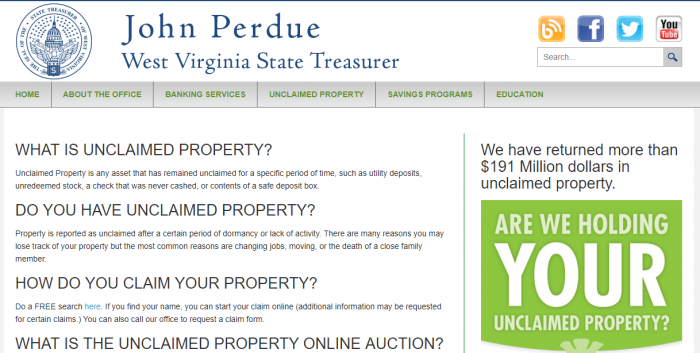
Your West Virginia unclaimed money search begins at the state’s unclaimed money website.
If you have never before run a search for unclaimed property or it has been a while since you have run a search, you may be curious and even somewhat intimidated by the process. Fortunately, since states have made unclaimed property databases available on their websites, the unclaimed property search process is actually fairly simple. Many states use the Missing Money database for their unclaimed property programs, while other states, like West Virginia, handle their own unclaimed property databases. Whether on Missing Money or a stand-alone site, the process is relatively similar in each state. This complete unclaimed property tutorial for West Virginia will not only help you navigate the unclaimed money process in West Virginia, but should also translate to other states. If you find yourself intimidated when you move to another state’s database, no problem: you can check out one of our other how-to guides.
Your West Virginia unclaimed money search begins at the state’s unclaimed money website.
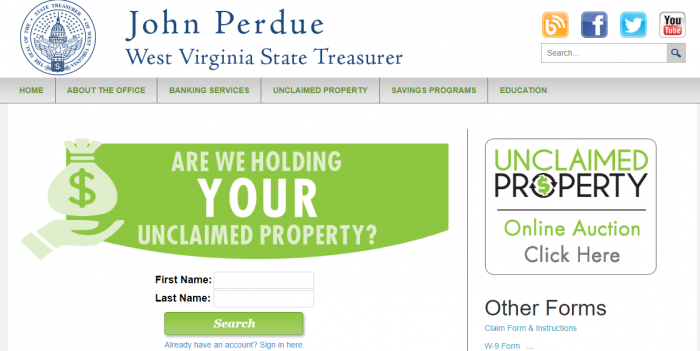 Some states have different parameters for the initial search, but West Virginia is similar to other state with relatively small populations and simply lets you put in your first name and last name for the search. You can run a last-name only search, but you will get back a greater number of search results.
In our tutorials, we use an alias to run an entire search, so that we can take you step-by-step through the search process. We also answer the most frequently asked questions we receive about the unclaimed money search process. We provide you with the web addresses and links you need to access West Virginia’s unclaimed money database and additional resources we suggest you use for your unclaimed money search. We also explain how you tailor your search, what documentation you may need to prove your claim, and discuss finder services.
Some states have different parameters for the initial search, but West Virginia is similar to other state with relatively small populations and simply lets you put in your first name and last name for the search. You can run a last-name only search, but you will get back a greater number of search results.
In our tutorials, we use an alias to run an entire search, so that we can take you step-by-step through the search process. We also answer the most frequently asked questions we receive about the unclaimed money search process. We provide you with the web addresses and links you need to access West Virginia’s unclaimed money database and additional resources we suggest you use for your unclaimed money search. We also explain how you tailor your search, what documentation you may need to prove your claim, and discuss finder services.
West Virginia’s Unclaimed Property Database
While having a statewide unclaimed property database may seem like the clear way to run an unclaimed property program, it is a relatively new concept. Before state treasurers operated unclaimed property programs for an entire state, unclaimed property might be retained by the original holder or held by the county. Either way, to find it usually meant searching in every county in a state. In West Virginia, that means that an unclaimed property search would have required individually searching all of the following counties: Barbour, Berkeley, Boone, Braxton, Brooke, Cabell, Calhoun, Clay, Doddridge, Fayette, Gilmer, Grant, Greenbrier, Hampshire, Hancock, Hardy, Harrison, Jackson, Jefferson, Kanawha, Lewis, Lincoln, Logan, McDowell, Marion, Marshall, Mason, Mercer, Mineral, Mingo, Monongalia, Monroe, Morgan, Nicholas, Ohio, Pendleton, Pleasants, Pocahontas, Preston, Putnam, Raleigh, Randolph, Ritchie, Roane, Summers, Taylor, Tucker, Tyler, Upshur, Wayne, Webster, Wetzel, Wirt, Wood, and Wyoming. Fortunately, today you no longer have to search in the individual counties; West Virginia’s state treasurer has information for the entire states.What is Unclaimed Money?
You may have heard references to unclaimed money, unclaimed property, abandoned money, and abandoned property. While each state has its preference about what it calls unclaimed money, all of these terms actually refer to the same thing. They are used to describe money that has an identified owner, and has been placed with a holder (like a bank or other business), but the holder has lost contact with the owner for a period of time. That period of time is defined by statutes and varies from state-to-state, and even within the same state depending on the type of property. While unclaimed property or money may also be called abandoned property or money, that term is a little misleading. When many people think of the word abandon, they think of someone intentionally losing possession of their property. In reality, most property is abandoned because it is forgotten and the original owner has failed to notify the holder of any changes in address, name, or phone number that would allow the holder to contact them. Once that occurs and the statutory time period elapses, the holder is obligated to report the property as unclaimed, to the State Treasurer, who then takes custody of the property and holds it for the original owner. While almost any type of personal property can become unclaimed property, the term is mainly used to identify intangible personal property like uncashed checks, security deposits, stocks, bonds, checking accounts, savings accounts, utility deposits, rebates, and the contents of safe deposit boxes. Some types of property are specifically exempted from becoming unclaimed property, such as land and motor vehicles. In addition, some holders may get a lien on property, which can relieve them of the obligation to report unclaimed property. A notable example of this is with storage units, which may have a lien on property for unpaid rent, which allows them to sell the contents of storage units at auction and keep the proceeds.How Much Unclaimed Money in West Virginia
West Virginia has approximately $230 million in unclaimed funds, although the current State Treasurer, John Perdue, has made huge strides in returning money to its owners. This is only a small fraction of the total amount of unclaimed money in the United States. The National Association of Unclaimed Property Administrators (NAUPA), estimates that there is more than $42 billion in unclaimed property available throughout the various states and territories.West Virginia Unclaimed Money Finder
In West Virginia, your unclaimed property search starts with a call or email to the State Treasurer or by going online.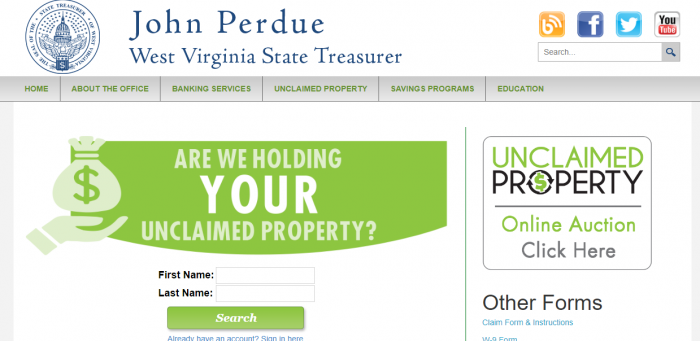 Beginning an unclaimed property search in West Virginia is easy: you simply begin your search by searching for a name. While West Virginia does not explicitly state that you can use business names, you can include a business name in lieu of a personal name in the “last name” box.
We use the same name in all of our tutorials, to make it easier for you to compare the search process across states. We use the name “Bob Smith.” We specifically chose a very common name because searching for common names can actually be more challenging than searching for unique names. While you are more likely to get search results, you are also likely to get a number of results that are not your property. In our tutorial, we will go over some strategies aimed at helping you find all of your property, while eliminating properties that do not belong to you.
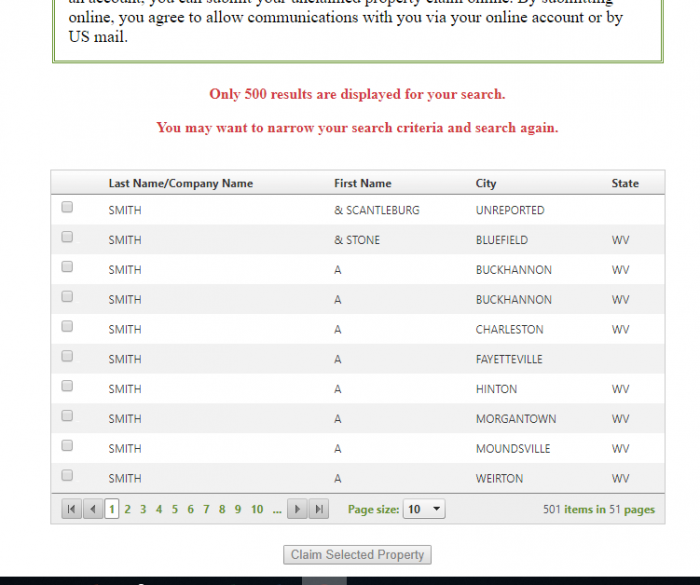
We begin the search by looking only for the last name “Smith.” There are 500 results, which is the maximum number of results that the West Virginia website will display. Therefore, the website gives us a message that we may want to narrow our search and try again:
Beginning an unclaimed property search in West Virginia is easy: you simply begin your search by searching for a name. While West Virginia does not explicitly state that you can use business names, you can include a business name in lieu of a personal name in the “last name” box.
We use the same name in all of our tutorials, to make it easier for you to compare the search process across states. We use the name “Bob Smith.” We specifically chose a very common name because searching for common names can actually be more challenging than searching for unique names. While you are more likely to get search results, you are also likely to get a number of results that are not your property. In our tutorial, we will go over some strategies aimed at helping you find all of your property, while eliminating properties that do not belong to you.
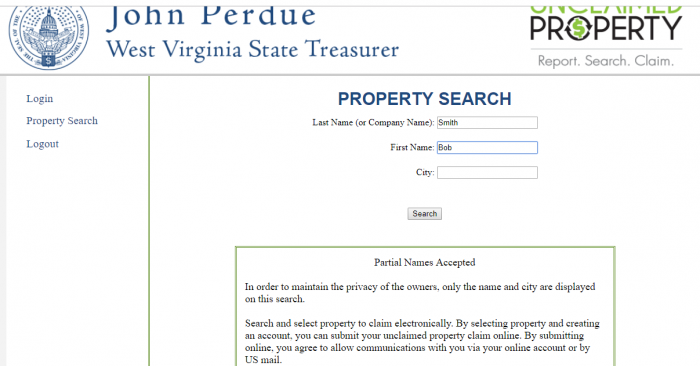
We begin the search by looking only for the last name “Smith.” There are 500 results, which is the maximum number of results that the West Virginia website will display. Therefore, the website gives us a message that we may want to narrow our search and try again:
 We narrowed our search criteria by looking for “Bob Smith” instead of just the last name Smith:
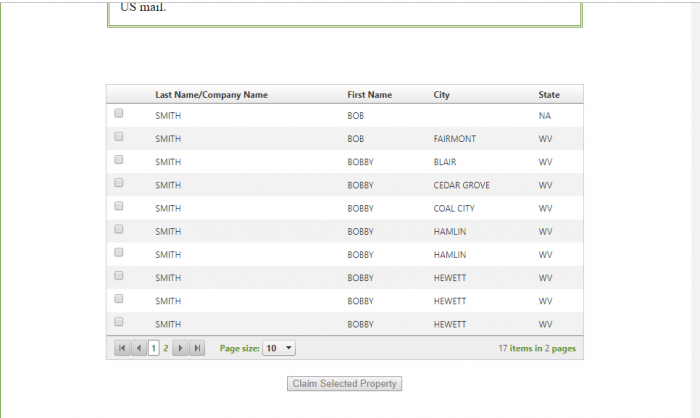 As you can see, narrowing the search came up with a much more manageable list of options: 17 results instead of over 500 results.
Different states provide different amounts of information on their unclaimed property pages. West Virginia provides very little information: it only provides last name, first name, city, and state. This can make it difficult to narrow down potential claims.
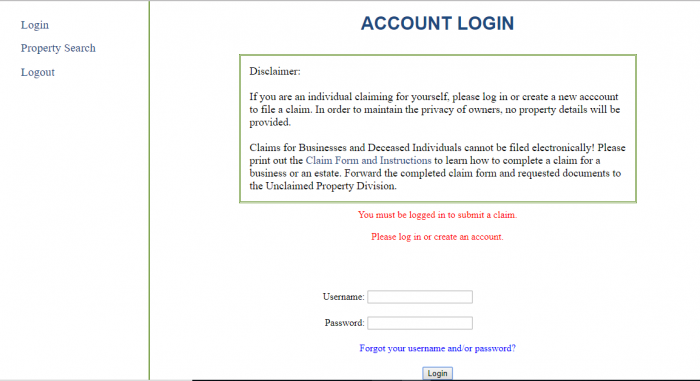
To select a claim, you highlight the check box to the left of each of the identified properties and, once you have finished selecting properties, you hit the “claim selected property” page. This is where West Virginia gets to be a little different than other states. In other states, you can submit claims for property without creating an account, but in West Virginia, you must create an account in order to be able to claim property. So, when you hit the “claim selected property” button, you are taken to a page that looks like this:
As you can see, narrowing the search came up with a much more manageable list of options: 17 results instead of over 500 results.
Different states provide different amounts of information on their unclaimed property pages. West Virginia provides very little information: it only provides last name, first name, city, and state. This can make it difficult to narrow down potential claims.
To select a claim, you highlight the check box to the left of each of the identified properties and, once you have finished selecting properties, you hit the “claim selected property” page. This is where West Virginia gets to be a little different than other states. In other states, you can submit claims for property without creating an account, but in West Virginia, you must create an account in order to be able to claim property. So, when you hit the “claim selected property” button, you are taken to a page that looks like this:
 To create a new account, you are taken to the following website.
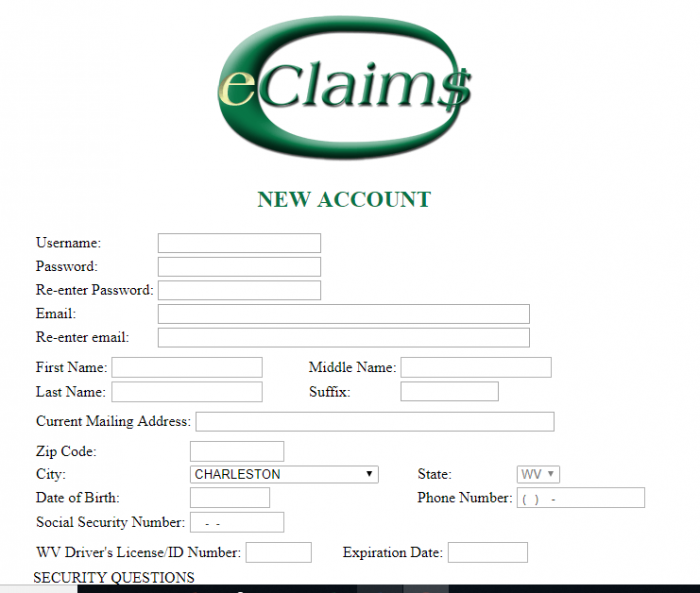 Creating an account asks you for the same type of information that you may be asked to provide when submitting a claim form in other states. This information includes your: first name, middle name, last name, current mailing address, city, zip code, state, date of birth, social security number, phone number, WV driver’s license ID number and expiration date, as well as account specific information like username, password, and security questions.
After you have filled in your account information, you can begin the claim process.
Creating an account asks you for the same type of information that you may be asked to provide when submitting a claim form in other states. This information includes your: first name, middle name, last name, current mailing address, city, zip code, state, date of birth, social security number, phone number, WV driver’s license ID number and expiration date, as well as account specific information like username, password, and security questions.
After you have filled in your account information, you can begin the claim process.
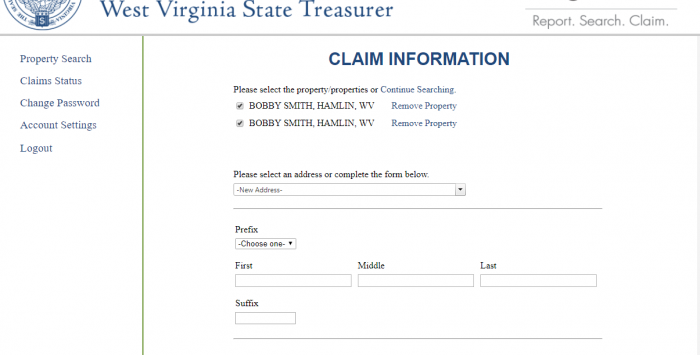
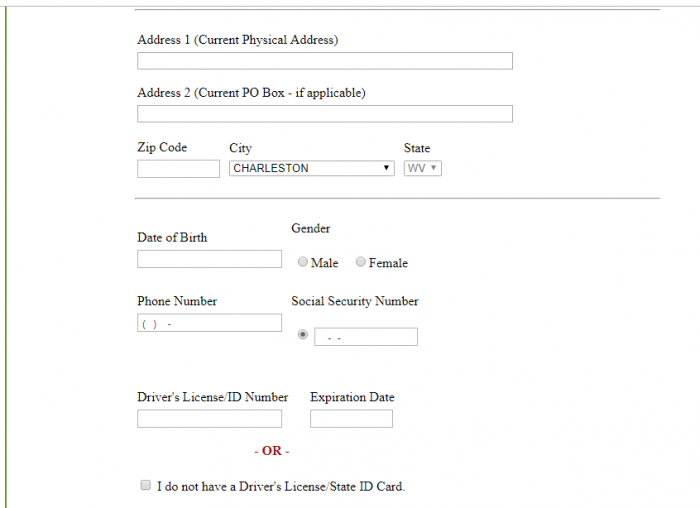
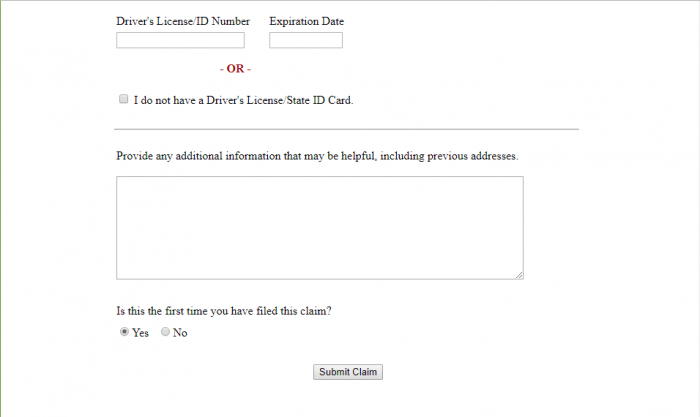 You will be asked for information specific to this claim, which may not match your original account information. For example, if you are claiming on behalf of the original owner and are actually an heir, executor, personal representative, or business owner.
Unclaimed Money Laws in West Virginia
West Virginia’s unclaimed money laws are located in the Uniform Unclaimed Property Act, West Virginia Code Chapter 36, Article 8; §§ 36-8-1 et al.West Virginia Unclaimed Money FAQ
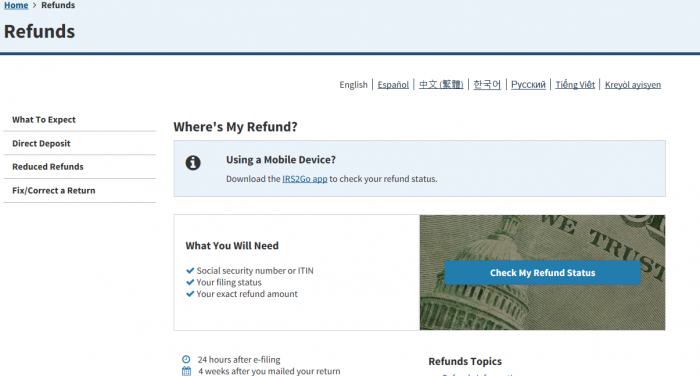
How long does West Virginia hold unclaimed money? West Virginia does not take possession of unclaimed property; it simply takes custody of the property. It will hold unclaimed property indefinitely until it can be claimed by the rightful property owner. Examples of Unclaimed Money Some of the most common examples of unclaimed money include: stocks, bonds, savings accounts, checking accounts, uncashed checks, insurance benefits or claims, security deposits, utility deposits, rebates, and the contents of safe deposit boxes. Does the state of WV make efforts to locate owners? West Virginia’s outreach efforts have been largely influenced by their State Treasurer, and the current Treasurer, John Perdue, has made efforts to reach out and inform the public about the unclaimed property program, though there are not significant efforts to inform individual unclaimed property owners. Other sources to search besides WV state database? Even if you have only ever lived in West Virginia, you may be surprised to find out that your property search needs to include some databases in addition to the West Virginia database. The list of other sites you need to include can be broken down into two categories: states where you have lived, established business contacts, or where people who may have left you property lived; and 2) national-level databases that may be tracking your property. You can search either one first; for ease, we begin with a discussion of other state databases. You might wonder why you need to include other states in your search. You might not; if your family has lived and worked in West Virginia for generations, then you might only need to search the state. However, you want to be sure and include all states where you are likely to have abandoned property. For most people this means expanding the search beyond West Virginia to include: every other state where you have resided; any states where your ancestors lived; any states where you have business contacts; and, finally, any states where someone may have put property in your name. For that last question, think about states where grandparents and aunts or uncles lived when you were born or celebrating any milestones. Once you have completed your list of state-level sites, you want to think about the national level sites you should include. These apply to almost every person, regardless of where they live, because the federal government does not turn over funds to state unclaimed property databases. There are four sites we consider must-search for most people: the Internal Revenue Service (IRS), the Pension Benefit Guaranty Corporation, the U.S. Treasury, and the Life Insurance Policy Locator. If you do not check any other national site, check the IRS. Not only does the IRS handle money for more property owners than any other organization in the country, it also has a policy of not forwarding income tax returns when an owner has moved. In addition, it does not report this money to state unclaimed property databases. You can find out more about their non-forwarding policy on the IRS website: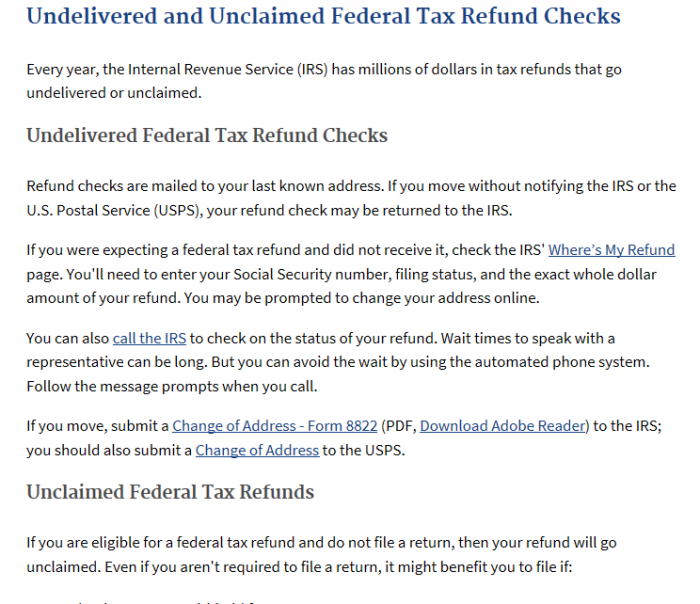 Therefore, if you think that you should have received an income tax refund, but did not, you should definitely check out the IRS’s Where’s My Refund? page.
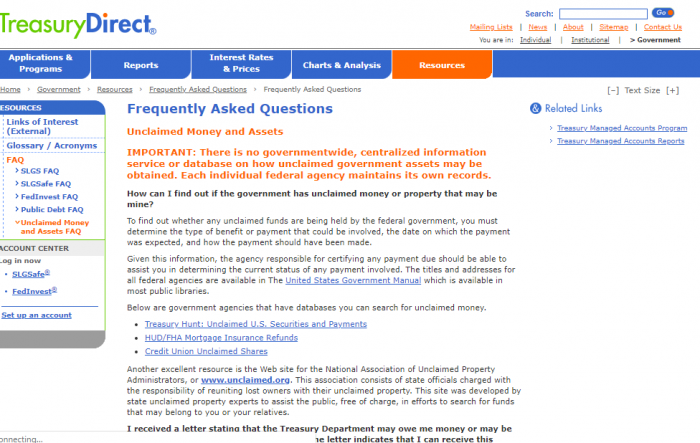
 Although it does not process near the same amount of money as the IRS, the U.S. Treasury is another significant holder. People purchase treasury bonds as investments and gifts, but may forget that they have the bonds. Unfortunately, while the IRS is easy-to-search, the Treasury is not. It once had a searchable abandoned property database on its website, but recently eliminated that service. You can still search for lost bonds by calling them at 844-284-2676 or visiting them at their website, Treasury Direct, for more information:
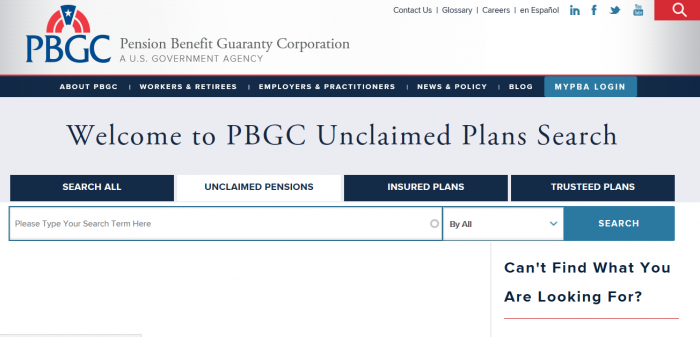
 While it may not apply to many people, there is another site worth checking: Pension Benefit Guaranty Corporation (PBGC). While pension benefits are private in the United States, what you may not realize is that the PBGC is a U.S. government agency dedicated to guaranteeing pension benefits. The PBGC operates a database to help people find their unclaimed pension benefits. Even if you are certain that you do not have any unclaimed pension benefits, this site is worth checking to see if any of your ancestors failed to claim their pension benefits:
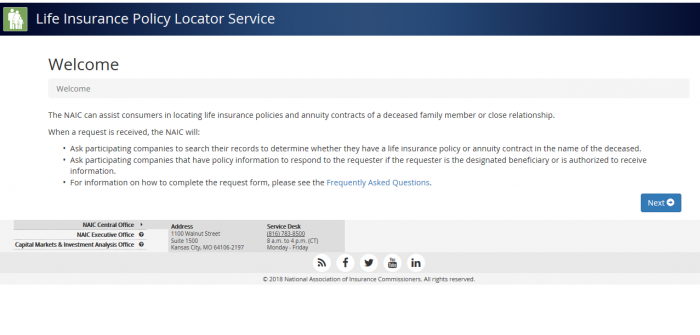
 The above sites are all part of the federal government, but not all national level unclaimed property sites are run by the government. The National Association of Insurance Commissioners’ Life Insurance Policy Locator Service is not a federal agency, but a conglomeration of member insurance agencies. It helps beneficiaries connect with life insurance policies, but does not operate like a traditional unclaimed property database. Instead of letting you search its records, it asks for information about you, which it distributes to its member companies and they use it to search to see if you have unclaimed benefits:
 It is important to keep in mind that no federal government agencies turn over their unclaimed property to state unclaimed property databases. Therefore, depending on your contacts with the federal government, you may need to check several other federal databases to see if you have money being held by them. The most popular include:: the FDIC, the Department of Housing and Urban Development, the National Credit Union Administration, and the Veteran’s Administration Benefits Department.
What is the best way prevent my property from becoming lost or unclaimed?
Unclaimed property usually becomes abandoned when people forget about it. Therefore, the best way to prevent property from becoming unclaimed is to set up a system of detailed information about your accounts, and to schedule regular contact with any and all property holders. In addition, make sure and update all of your accounts anytime you have a change in information like your address, name, marital status, or phone number. One of the ways to make this easier is to choose electronic account management, when available. In addition, you should respond when your financial institutions attempt to communicate with you.
How do I make sure my heirs know where my assets are if I die?
Do not make the common mistake of assuming that a will is enough. A will does not tell your heirs or executors where to find the property in question. Instead, you need to appoint a trusted individual to have access to your accounts in the event you die or become incapacitated. You should leave them with the information that they need to access your account records.
Should I hire a finder to conduct the search?
West Virginia does not specifically address the use of finder services. Finder services, also known as locator services, are third parties that charge a fee to search for and claim your unclaimed property. Generally, property searches and claims are free, so you do not need to pay a finder. However, if you do not have the time to run your own searches, you may choose to pay the fee in order to recover the money more quickly.
Why does West Virginia take possession of unclaimed property?
There are two reasons that states take possession of unclaimed property. First, it is a consumer protection action, which is aimed at making it more likely that people will be reunited with their unclaimed property by consolidating that property into a central location. Second, it provides an advantage to the state, which uses that property to generate income for the state until the property can be claimed by the property owner.
It is important to keep in mind that no federal government agencies turn over their unclaimed property to state unclaimed property databases. Therefore, depending on your contacts with the federal government, you may need to check several other federal databases to see if you have money being held by them. The most popular include:: the FDIC, the Department of Housing and Urban Development, the National Credit Union Administration, and the Veteran’s Administration Benefits Department.
What is the best way prevent my property from becoming lost or unclaimed?
Unclaimed property usually becomes abandoned when people forget about it. Therefore, the best way to prevent property from becoming unclaimed is to set up a system of detailed information about your accounts, and to schedule regular contact with any and all property holders. In addition, make sure and update all of your accounts anytime you have a change in information like your address, name, marital status, or phone number. One of the ways to make this easier is to choose electronic account management, when available. In addition, you should respond when your financial institutions attempt to communicate with you.
How do I make sure my heirs know where my assets are if I die?
Do not make the common mistake of assuming that a will is enough. A will does not tell your heirs or executors where to find the property in question. Instead, you need to appoint a trusted individual to have access to your accounts in the event you die or become incapacitated. You should leave them with the information that they need to access your account records.
Should I hire a finder to conduct the search?
West Virginia does not specifically address the use of finder services. Finder services, also known as locator services, are third parties that charge a fee to search for and claim your unclaimed property. Generally, property searches and claims are free, so you do not need to pay a finder. However, if you do not have the time to run your own searches, you may choose to pay the fee in order to recover the money more quickly.
Why does West Virginia take possession of unclaimed property?
There are two reasons that states take possession of unclaimed property. First, it is a consumer protection action, which is aimed at making it more likely that people will be reunited with their unclaimed property by consolidating that property into a central location. Second, it provides an advantage to the state, which uses that property to generate income for the state until the property can be claimed by the property owner.
Conclusion
As a relatively small state, it should come as no surprise that West Virginia has a relatively small percentage of the country’s $42 billion in unclaimed property. However, it does have a significant amount of unclaimed property and the process to search for and claim it is free. What do you have to lose?Search Unclaimed Money in Other States
Looking for unclaimed money in a different state? Browse all 50 states below to find unclaimed property in your area.
ALAlabamaAKAlaskaAZArizonaARArkansasCACaliforniaCOColoradoCTConnecticutDEDelawareFLFloridaGAGeorgiaHIHawaiiIDIdahoILIllinoisINIndianaIAIowaKSKansasKYKentuckyLALouisianaMEMaineMDMarylandMAMassachusettsMIMichiganMNMinnesotaMSMississippiMOMissouriMTMontanaNENebraskaNVNevadaNHNew HampshireNJNew JerseyNMNew MexicoNYNew YorkNCNorth CarolinaNDNorth DakotaOHOhioOKOklahomaOROregonPAPennsylvaniaRIRhode IslandSCSouth CarolinaSDSouth DakotaTNTennesseeTXTexasUTUtahVTVermontVAVirginiaWAWashingtonWIWisconsinWYWyoming